.webp)


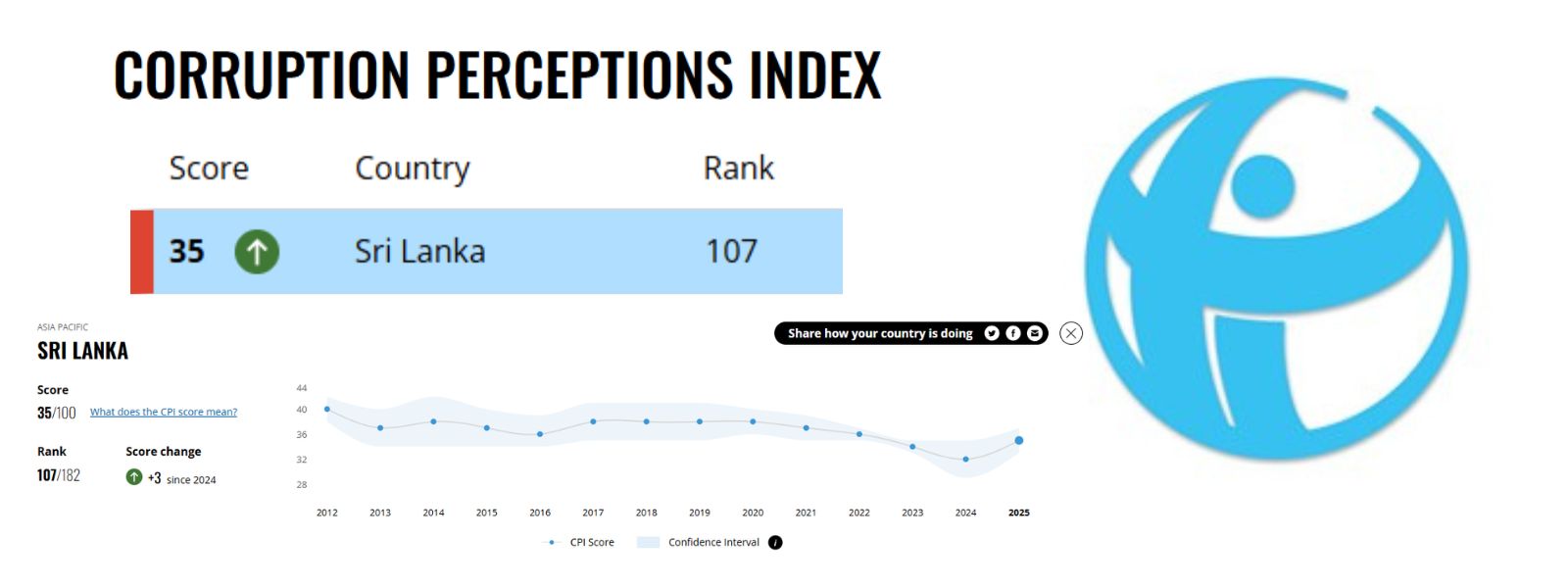
Sri Lanka Jumps 14 Places in Global Corruption Perceptions Index



.png )
COLOMBO (News 1st); Sri Lanka has recorded a notable improvement in its global standing on the Corruption Perceptions Index (CPI) 2025 by Transparency International, marking one of the country’s most significant jumps in recent years.
According to the latest CPI release, Sri Lanka has risen from Rank 121 in 2024 to Rank 107 in 2025, reflecting a 14‑position climb.
The Corruption Perceptions Index (CPI) is the most widely used global corruption ranking in the world. It measures how corrupt each country’s public sector is perceived to be.
In 2024, Sri Lanka hit its worst-ever CPI rank of 121, placing it among the most corrupt third of the 180 countries reviewed.
The CPI ranks 182 countries and territories by their perceived levels of public sector corruption on a scale of zero (highly corrupt) to 100 (very clean).
The global average score stands at 42 out of 100, its lowest level in more than a decade, pointing to a concerning downward trend that will need to be monitored over time.
The vast majority of countries are failing to keep corruption under control: more than two-thirds – 122 out of 180 – score under 50.
For the eighth year in a row, Denmark obtains the highest score on the index (89) and is closely followed by Finland (88) and Singapore (84).
Countries with the lowest scores overwhelmingly have severely repressed civil societies and high levels instability like South Sudan (9), Somalia (9) and Venezuela (10).
Transparency International says that corruption is worsening globally, with even established democracies experiencing rising corruption amid a decline in leadership.
The annual index shows that the number of countries scoring above 80 has shrunk from 12 a decade ago to just five this year.
TI data show that democracies, typically stronger on anti-corruption than autocracies or flawed democracies, are experiencing a worrying decline in performance.
This trend spans countries such as the United States (64), Canada (75) and New Zealand (81), to various parts of Europe, like the United Kingdom (70), France (66) and Sweden (80). Another concerning pattern is increasing restrictions by many states on freedoms of expression, association and assembly.
Since 2012, 36 of the 50 countries with significant declines in CPI scores have also experienced a reduction in civic space.
The data sources used to compile the CPI specifically cover the following manifestations of public sector corruption:
Bribery
Diversion of public funds
Officials using their public office for private gain without facing consequences
Ability of governments to contain corruption in the public sector
Excessive red tape in the public sector which may increase opportunities for corruption
Nepotistic appointments in the civil service
Laws ensuring that public officials must disclose their finances and potential conflicts of interest
Legal protection for people who report cases of bribery and corruption
State capture by narrow vested interests
Access to information on public affairs/government activities
Other Articles
-842063_550x300.jpg)

-842050_550x300.jpg)
-842044_550x300.jpg)




Featured News


-835300_550x300.jpg)


News 1st, MTV Channel (Pvt) Ltd, MBC Networks (Pvt) Ltd, 45/3, Braybrooke Street, Colombo-02.
T.P : +94 114 792 700,
Fax : +94 114 792 733
T.P : +94 114 792 700,
Fax : +94 114 792 733




 |  |  |
|---|---|---|
 |  |  |
 |  |  |
 |

.gif)