.webp)


When a Country Stood Up: The Volunteer Wave Behind ‘Sahana Yathra’



.png )
COLOMBO (News 1st); As Cyclone Ditwah tore through Sri Lanka, a different kind of tide rose to meet it – a human tide of unpaid, unseen volunteers powering the Sirasa Sahana Yathra relief drive into a full-blown people’s movement of hope. This story is about the people, who made it happen.
Studios that never slept:
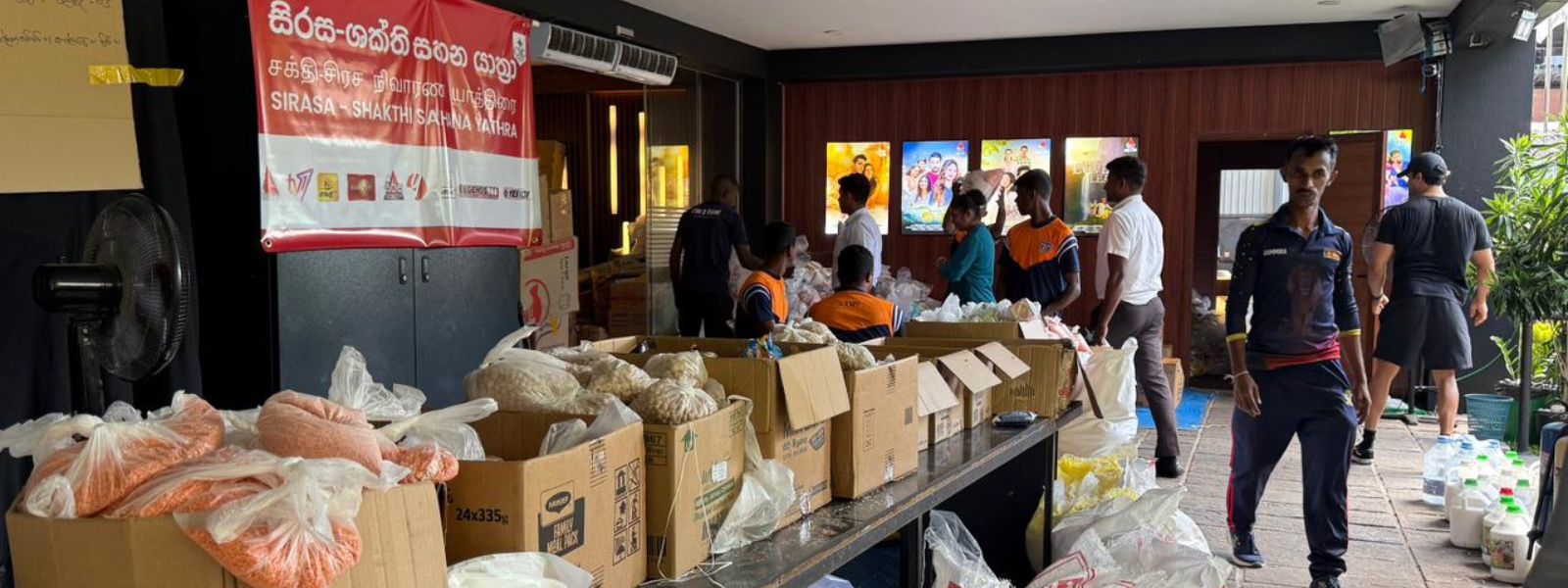
At Stein Studios in Ratmalana, Sirasa’s transmission Center in Pannipitiya and the networks HQ in downtown Colombo, the floodlights stayed on long after prime time ended. And it was here, that something remarkable was unfolding. Sahana Yathra — a local phrase meaning ‘a convoy of relief and hope’ — came alive not through branding or broadcast, but through the hands of volunteers who worked through the night to help families they would never meet.
What were ordinarily media workspaces within the Maharaja Media Network, owned by CMG, became practical hubs for organising the effort. The significant network operating within The #Gammadda Movement, the organizations national rural development initiative, was harnessed immediately for this purpose.
Pallets of rice and dhal shared floor space with camera dollies; rows of water bottles rose like makeshift battlements against the dark. Outside, trucks lined up in a queue that seemed to refresh itself every hour. Inside, the loudest sound wasn’t from a studio monitor – it was from tape guns, rustling poly-sacks and exhausted chatter. University students in faculty T-shirts, office workers still in their formal shoes, schoolchildren with makeshift name tags – all of them bent over the same task: packing ration packs for families they would never meet.
One Facebook post from a volunteer captured the mood: “Hundreds of volunteers are coming together to pack dry rations for those affected and in need.”
Over the past ten days, that scene – replicated in Colombo, Kandy, Gampaha and beyond – has turned Sirasa–Shakthi Sahana Yathra from a media-led aid drive into something far bigger: a nationwide volunteer uprising of compassion.
A country inspired to fight back:
Cyclone Ditwah has been described by officials as one of the gravest natural disasters in Sri Lanka’s recent history. As of 2nd December, the Disaster Management Centre (DMC) reported 410 fatalities, 336 missing, and over 233,000 people displaced to more than 1,400 welfare centres across 22 districts.
International wires have since pushed that figure even higher, with at least 355 dead and 366 missing reported in the days that followed as floodwaters and landslides revealed the true extent of the devastation. Reuters
Entire neighbourhoods in Kandy, Badulla, Matale and Nuwara Eliya have been gouged out by earth slips; low-lying suburbs around Colombo were transformed into brown lakes, forcing families onto school floors and temple verandahs.
In that landscape of loss, the question was brutally simple: how quickly could help move?
The birth of Sahana Yathra – “bring what you can, today”
On 27th November, President Anura Kumara Dissanayake called for an immediate all-of-government disaster response as severe weather bore down on the island.
Within hours, Sirasa TV and Shakthi TV, two national channels run by The Maharaja Media Network, announced what would become the defining citizen response to the crisis.
On 28th November, News 1st reported on the launch of Sirasa–Shakthi Sahana Yathra, describing it as Sri Lanka’s “storm-torn reality meeting a new wave of solidarity.” Collection centres opened in Colombo and other key locations, appealing for dry rations, drinking water, clothing, medicines, hygiene items and bedding – anything that could keep a stranger alive and dignified through the worst days.
The language of the campaign was intentionally simple: Bring what you can. Bring it now. We’ll get it where it needs to go.
From broadcast to movement
By the very next night, those words were already being translated into action.
On 29th November, Sahana Yathra began distributing public donations to safe shelters in Kolonnawa, where families displaced by the overflowing Kelani River were crowding into temporary accommodation. Volunteers and staff delivered packs of dry rations, moving from mat to mat in classrooms turned into dormitories.
What followed over the next 10 days was a tempo more common to a breaking-news story than a relief drive. In an article on the second major convoy, News 1st described back-to-back deployments, overnight sorting lines and on-air appeals that turned into truckloads by morning. The report called Sahana Yathra “more than an aid drive – a movement of solidarity.” News First
The evidence of that movement is everywhere:
A Colombo gym and training centre declared itself a collection point, urging members to bring dry rations, with every contribution directed to Sahana Yathra.
Campus societies and student unions in institutions like KDU’s Faculty of Technology and BMS ran flood-relief camps, handing over everything collected – from rice to toiletries – to the Sahana Yathra team at Stein Studios, Ratmalana. Café chains such as Barista mobilised their “family” of staff and customers to support Sahana Yathra, using their outlets as micro-hubs for donations and logistics. School announcements invited students to bring items from home, explicitly noting that their contributions would be channelled through Sahana Yathra to the worst-hit areas.
Every one of these efforts was voluntary. Every truck, every pallet, every neat stack of ration packs represented thousands of small acts of freely given time, money and labour.
Land, water, air – powered by unpaid hands
On 1st December, Sahana Yathra officially entered Phase II. The headline said it all:
“Land, Water, Air: Sirasa Sahana Yathra Moves Into Phase II With Expanded Deployment Push.” News First
The article described:
Dozens of trucks loaded with dry rations, water, clothing, hygiene kits and bedding rolling out from collection centres in Colombo, Kandy, Ratmalana and Kotahena, heading for districts including Puttalam, Kurunegala and Gampaha. Boats, deployed in collaboration with Sarvodaya and Sri Lanka Life Saving, ferrying supplies across submerged roads into marooned communities. The first air-lift of relief supplies under the Sahana Yathra banner, operated with the Sri Lanka Air Force, a Mi-17 helicopter crew from the Indian Air Force, and the Disaster Management Centre (DMC) – with more flights expected.
Buried in that same report was a single, crucial line about how all of this became possible: Local volunteers, in response to public appeals, helped pack and load supplies late into the night. News First
“Behind every land convoy, boat mission and air-lift, there was an invisible second operation: one in which volunteers stood at trestle tables for hours, measured portions, labelled packs, carried sacks, updated manifests, answered calls and simply refused to go home until the last truck rolled out”, noted Chevaan Daniel, the Head of The Maharaja Media Network and also, the Leader of the Gammadda Movement.
The quiet army behind the cameras
Sahana Yathra’s most powerful images have not just been of helicopters and convoys. They have been of people.
A Facebook post – shared thousands of times – spoke of volunteers working 24 hours without proper sleep or a meal, giving “everything they could” to contribute thousands of rupees worth of donations through Sahana Yathra. Facebook
Social media clips show:
Youth and old boys’ associations joining hands with Shakthi and Sirasa Sahana Yathra, turning their networks into distribution arms for ration packs.
Cricketers from upcountry towns using a rare day in Colombo to spend time at a Braybrooke Place collection point, helping pack and load supplies. Facebook
Volunteers being invited not just to donate goods, but to “cook, pack or serve”, because “all hands are welcome.”
Some of these volunteers are themselves from flood-affected districts. Others are students facing their own economic pressures. None of them are being paid.
In a country where trust in institutions has frayed, what Sahana Yathra has unlocked is something different: trust in one another.
Unity beyond every divide
An operation of this scale could easily have become a siloed brand exercise. Instead, Sahana Yathra has become shorthand for collaboration across lines that usually divide Sri Lanka.
A quick scan of partners and supporters tells the story:
Corporate Sri Lanka – from fashion labels like Arienti, which donated clothing for families who lost everything, to tech and finance companies that used their offices as satellite collection points. Education sector – universities and schools, public and private, Sinhalese and Tamil-medium, inviting students to be part of “Sirasa Sahana Yathra initiative” days.
Diaspora and international allies, whose donations were explicitly channelled to Sahana Yathra by local partners, trusting that this was the quickest route to the frontlines. In each case, the choice of partner was all about trust, reach and readiness. At a time when nations are often described in terms of fractures – north vs south, urban vs rural – the Sahana Yathra map has looked very different: a web of hands passing boxes from one person to the next, from one district to another.
Accountability in the age of scrutiny
In a climate where disaster relief efforts are rightly scrutinised, Sahana Yathra has operated in the full glare of the camera.
News 1st reports have consistently highlighted the institutional framework around the initiative:
coordination with the Disaster Management Centre (DMC),
operational integration with the Sri Lanka Air Force and other international organizations, including the Indian Air Force for air drops, collaboration with established humanitarian actors such as Sarvodaya and Sri Lanka Life Saving for boat operations, clear identification of collection centres and destinations in on-air and online updates. News First+1
This level of transparency – from showing the packed warehouses to broadcasting from shelters where goods are delivered – has helped address a crucial question in every donor’s mind: “Will what I give actually reach someone who needs it?”
The answer, in the case of Sahana Yathra over these ten days, has been visible in near real-time.
From the shelters: “We did not feel forgotten”
While the cameras often focus on trucks leaving, the most important moments have been when they arrive.
In shelters from Kolonnawa to Kurunegala, families have spoken of the psychological relief that came not just from receiving a ration pack, but from realising that someone, somewhere, had thought of them.
Social media posts from partner organisations and individual volunteers tell the same story in different words:
gratitude at being allowed to “stand with Sirasa’s Sahana Yathra initiative during this challenging time,”
pride in being “part of Sirasa Shakthi Sahana Yathra” as they hand over ration packs to families who had lost everything, a recurring refrain from many who helped: “This was the least we could do.”
In a disaster defined by numbers – dead, missing, displaced – Sahana Yathra’s volunteer movement has insisted on seeing people, one pack, one family, one story at a time.
The template for the Sri Lanka we keep saying we want
Cyclone Ditwah will eventually move out of the headlines. The waters will recede. The cameras will turn elsewhere.
But the past ten days of Sahana Yathra have quietly proven a few truths we often forget:
That Sri Lankans, regardless of ethnicity, language or class, are still willing to stand in the same queue to help someone they will never meet. That young people will work through the night on nothing more than a phone call, a post and a shared sense of duty. That when institutions open their doors and offer their logistics and platforms to the public, citizens will respond – in numbers far beyond what any one organisation could command.
Natural disasters are inevitable. Governments around the world, and systems will continue to struggle under the weight of climate-driven extremes.
But Sahana Yathra has shown that Sri Lanka’s inexhaustible resource is its volunteer spirit.
Other Articles








Featured News

News 1st, MTV Channel (Pvt) Ltd, MBC Networks (Pvt) Ltd, 45/3, Braybrooke Street, Colombo-02.
T.P : +94 114 792 700,
Fax : +94 114 792 733
T.P : +94 114 792 700,
Fax : +94 114 792 733




 |  |  |
|---|---|---|
 |  |  |
 |  |  |
 |

.gif)