.webp)


Strongest El Niño in 75 Years? Sri Lanka Faces Climate Uncertainty Ahead



.png )
COLOMBO (News 1st); For many Sri Lankans, the unusually hot days, shrinking reservoirs and prolonged dry spells have felt abnormal.
Scientists now believe there may be a powerful reason why.
The Department of Meteorology says Sri Lanka could soon find itself confronting one of the strongest El Niño events in the last 75 years, a climate phenomenon capable of dramatically altering weather patterns across the globe and bringing both droughts and floods to different regions.
According to Director General of Meteorology Ajith Wijemannage, international forecasts currently indicate a 69 percent probability that the ongoing El Niño could develop into an exceptionally powerful event.
The warning comes as large parts of the country outside the southwestern region continue to experience prolonged dry weather conditions.
Meteorologists say the El Niño currently active in the Pacific Ocean is already influencing weather conditions in Sri Lanka.
The last major El Niño event to significantly affect the country occurred in 2016, when sea surface temperatures in the central Pacific Ocean reached 2.76 degrees Celsius above average during November.
Today, the numbers are once again moving in a worrying direction.
Recent observations show temperatures in the central Pacific have already risen to 2.2 degrees Celsius above normal levels, with further increases expected in the coming months.
Forecasts issued by the Australian Bureau of Meteorology suggest the warming could intensify to around 3.4 degrees Celsius by November and 3.5 degrees Celsius by December.
According to those projections, a phenomenon of this strength has not been recorded since 1900.
So what does Sri Lanka's Meteorology Department think?
Director General Ajith Wijemannage says the world's leading climate prediction centres are closely monitoring the situation.
"Global forecasts, particularly those from the NOAA Prediction Center, indicate that the El Niño phenomenon is expected to strengthen considerably. Current forecasts suggest, with a probability exceeding 90 percent, that by October, November and December this year, El Niño is likely to become a very strong event."
He explained that scientists use the Oceanic Niño Index (ONI) to measure the strength of El Niño.
"At present, the Oceanic Niño Index for the three-month period covering May, June and July is showing a positive value of around 1.4 degrees Celsius."
"We classify conditions as El Niño once that value exceeds positive 0.5 degrees Celsius. When the value exceeds positive 1.0 degrees Celsius, it is considered a moderate El Niño event."
While current measurements indicate moderate El Niño conditions, Wijemannage says the phenomenon is continuing to evolve.
"Although the latest three-month period indicates 1.4 degrees Celsius, El Niño assessments are based on longer observations. Nevertheless, at present, we are experiencing a moderate El Niño. While its impact on Sri Lanka has so far been limited, it is already affecting different regions of the world in different ways."
Could it become a "Super El Niño"?
The response from the Meteorology Department is striking.
"There is a 69 percent probability that the 2026-2027 El Niño event will become stronger than the El Niño events experienced during the past 75 years."
That prediction naturally leads to another question.
Will Sri Lanka face severe drought or severe flooding?
According to meteorologists, the answer may be both.
"We are not expecting a continuous drought, nor are we expecting continuous rainfall. What we anticipate is a combination of both extremes."
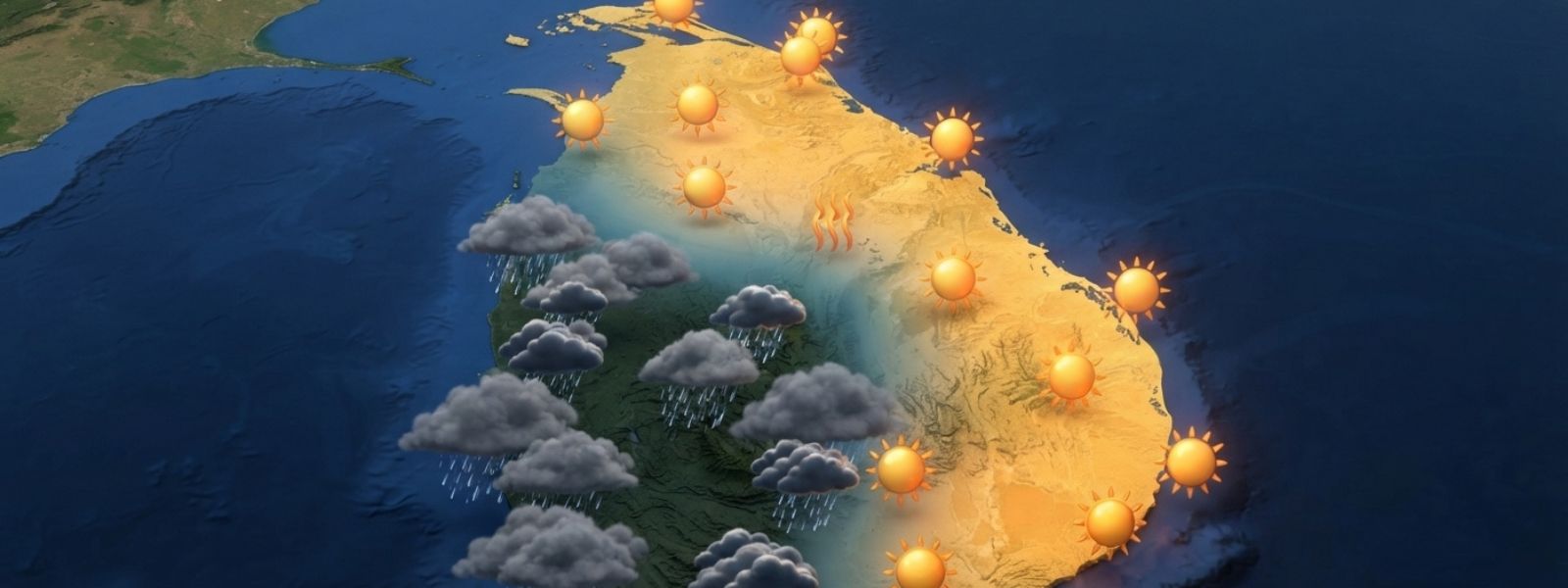
For the immediate future, rainfall is expected to remain below normal in the Northern, North Central and Eastern Provinces, as well as parts of the Uva Province, including districts such as Monaragala.
However, conditions will be different elsewhere.
"We expect periodic rainfall in the Southwestern Province, Sabaragamuwa, the Western Province and districts such as Galle, Matara, Kandy and Nuwara Eliya. Some parts of the North Western Province are also expected to receive rain."
Despite this, most regions are not expected to receive significant rainfall during the early part of September.
The outlook begins to change later in the year.
"We expect rainfall activity to increase during the latter part of September."
According to the Department of Meteorology, rainfall during October and November is likely to exceed long-term seasonal averages.
"We anticipate above-average rainfall during both October and November."
The effects may not end there.
"The October-November rains may continue into December and possibly even into the early weeks of January."
The greatest impact is expected in the Northern, Eastern and North Central Provinces, particularly as the Northeast Monsoon becomes active.
"During December and January, we expect higher rainfall in the Northern, Eastern and North Central Provinces because the Northeast Monsoon becomes active during this period. The strengthening of the Northeast Monsoon is one of the key impacts associated with this El Niño event."
For Sri Lanka, the emerging picture is one of uncertainty and extremes.
Reservoirs are already drying up in several districts, farmers are watching the skies anxiously, and meteorologists are tracking a warming Pacific Ocean that could influence weather patterns for months to come.
Whether it arrives as scorching droughts, intense rainfall, or a combination of both, one thing is becoming increasingly clear: the next chapter of Sri Lanka's weather story may be written away in the waters of the Pacific Ocean.
Other Articles









Featured News


-849213_550x300.jpg)

-848028_550x300.jpg)
News 1st, MTV Channel (Pvt) Ltd, MBC Networks (Pvt) Ltd, 45/3, Braybrooke Street, Colombo-02.
T.P : +94 114 792 700,
Fax : +94 114 792 733
T.P : +94 114 792 700,
Fax : +94 114 792 733




 |  |  |
|---|---|---|
 |  |  |
 |  |  |
 |

.gif)