.webp)


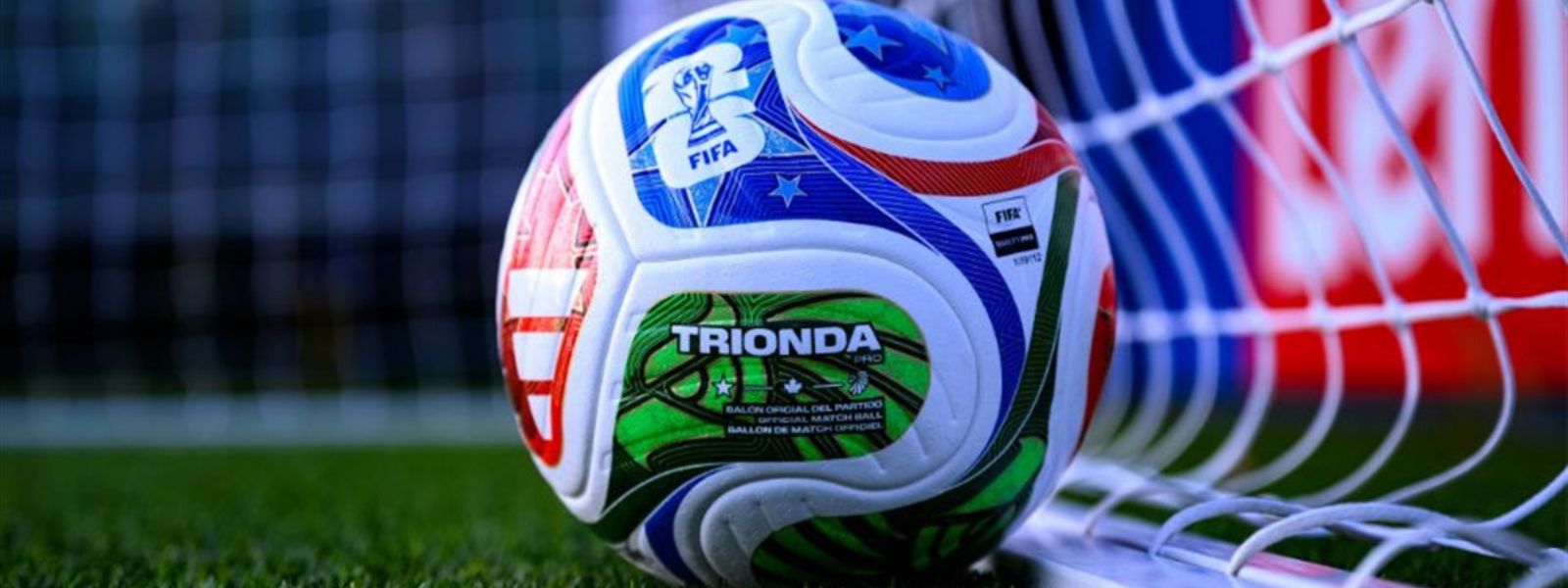
FIFA 2026 Brings 'Trionda' Ball with Game-Changing VAR



.png )
COLOMBO (News 1st) The FIFA World Cup 2026 is shaping up to be one of the most revolutionary editions in the history of global football, not only because of its expanded format and tri-nation hosting but also due to groundbreaking technological innovations that promise to redefine the game.
Among the most striking advancements is the introduction of the official match ball, ‘Trionda’, a cutting-edge creation developed by Adidas that blends traditional football craftsmanship with sophisticated data technology.
Set to be hosted across the United States, Mexico, and Canada, the 2026 tournament will already mark a historic milestone with the largest participation pool ever seen in the competition.
However, the unveiling of the ‘Trionda’ ball has further underscored FIFA’s ambition to deliver a tournament that merges sport, precision, and innovation at an unprecedented level.
The term ‘Trionda’, derived from Spanish and meaning ‘three waves’, reflects not only the three host nations but also the dynamic, fluid nature of the modern game.
Yet the real significance of the ball lies beneath its surface. Embedded within it is a highly advanced inertial measurement unit (IMU) sensor chip, a technology that represents a major leap forward in football analytics and officiating.
This tiny yet powerful sensor captures data 500 times per second, meticulously tracking the ball’s speed, acceleration, and movement in three-dimensional space.
Such comprehensive data collection allows officials to understand every nuance of the ball’s trajectory, offering unprecedented insight into moment-to-moment gameplay.
According to FIFA, the integration of this sensor is designed to significantly enhance the effectiveness and accuracy of the Video Assistant Referee (VAR) system.
The real-time data transmitted by the ball provides officials with precise information that can be crucial in making decisions, particularly in complex situations such as offside calls, handball incidents, and disputed deflections. FIFA’s Head of Research & Standards, Nicolas Evans, emphasized the transformative nature of the technology, explaining that the sensor essentially reveals
“what the ball is doing in a 3D space.” This capability ensures that referees are supported by objective, data-driven insights, minimizing human error and increasing fairness in the game.
At a match, there will be between 15 and 20 of these smart balls ready and charged with each one lasting 6 hours if being used in play.
Sources: Inside FIFA, Al-Jazeera,BBC
Other Articles


-842164_550x300.jpg)






Featured News


-835300_550x300.jpg)


News 1st, MTV Channel (Pvt) Ltd, MBC Networks (Pvt) Ltd, 45/3, Braybrooke Street, Colombo-02.
T.P : +94 114 792 700,
Fax : +94 114 792 733
T.P : +94 114 792 700,
Fax : +94 114 792 733




 |  |  |
|---|---|---|
 |  |  |
 |  |  |
 |

.gif)