.webp)


Sri Lanka Hits Major IMF Target: Fuel & Electricity Prices Now Fully Cost-Reflective



.png )
COLOMBO (News 1st); Sri Lanka has achieved a critical milestone in its economic recovery programme, with the International Monetary Fund (IMF) confirming that the country has successfully met cost recovery pricing for both electricity and fuel, aligning with key reform targets under the Extended Fund Facility (EFF).
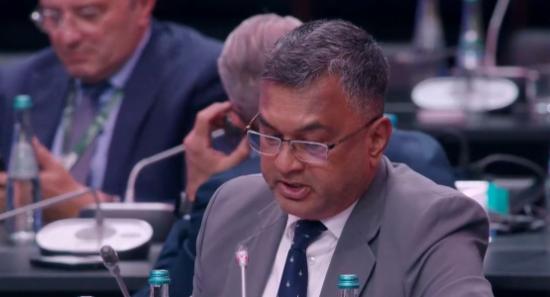
The confirmation came in response to a question raised by News 1st's Zulfick Farzan, who sought clarity on whether the Central Bank’s recent assertion on electricity pricing aligns with IMF programme benchmarks.
Responding directly, IMF Mission Chief for Sri Lanka, Evan Papageorgiou, affirmed that cost recovery has indeed been achieved, describing it as a core commitment under the ongoing IMF-supported reform programme. He stated that restoring cost-reflective pricing mechanisms for both electricity and fuel has been a central pillar of Sri Lanka’s economic adjustment efforts and confirmed that authorities have fulfilled the required conditions.
Papageorgiou further noted that the implementation of these pricing adjustments was a key precondition for the IMF to proceed with its latest Executive Board review.
According to him, Sri Lankan authorities have demonstrated full commitment to ensuring that energy pricing reflects actual costs, marking a significant step toward stabilizing public finances.
He acknowledged that earlier this year, global economic pressures, particularly rising commodity and oil prices, delayed necessary adjustments, creating a temporary gap between actual costs and consumer tariffs. This resulted in a short-lived subsidy burden on both electricity and fuel sectors.
However, he explained that corrective actions taken in recent months successfully addressed this imbalance. Fuel prices were revised upward in line with global market rates, while electricity tariffs underwent a second increase, averaging around 11 percent, as part of prior actions tied to the combined fifth and sixth reviews of the IMF programme.
“These measures together have brought both fuel and electricity tariffs back in line with cost recovery levels,” Papageorgiou said, emphasizing that Sri Lanka is now back on track with its pricing reforms.
Looking ahead, the IMF has underscored the importance of maintaining transparent and cost-reflective pricing mechanisms. Papageorgiou stated that the government has committed to continuing timely adjustments to fuel prices, including petrol and diesel, and electricity tariffs to reflect fluctuations in global energy costs.
He confirmed that current pricing formulas are now being applied as intended, ensuring sufficient revenue generation to cover production, import, and operational expenses within the energy sector.
Addressing concerns about the public impact of rising energy costs, Papageorgiou noted that a temporary fuel subsidy introduced in April remains in place to cushion the effects of recent price increases. He clarified that this subsidy is time-bound and has been factored into the national budget.
Other Articles








Featured News


-835300_550x300.jpg)

News 1st, MTV Channel (Pvt) Ltd, MBC Networks (Pvt) Ltd, 45/3, Braybrooke Street, Colombo-02.
T.P : +94 114 792 700,
Fax : +94 114 792 733
T.P : +94 114 792 700,
Fax : +94 114 792 733




 |  |  |
|---|---|---|
 |  |  |
 |  |  |
 |

.gif)