.webp)


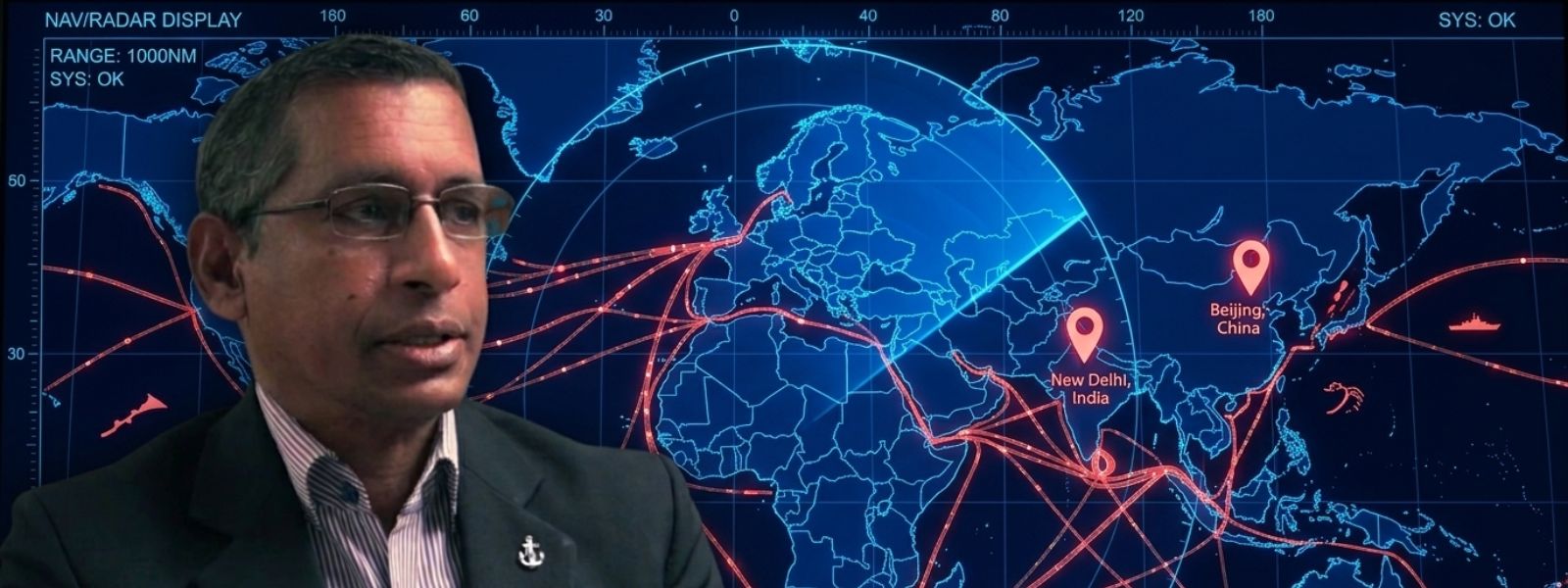
Sri Lanka Must Understand India and China to Navigate Global Pressures



.png )
COLOMBO (News 1st); Rear Admiral (Retd) Y. N. Jayarathna, former Chief Hydrographer of Sri Lanka, has stressed the urgent need for Sri Lanka to deepen its understanding of both India and China in order to effectively navigate an increasingly complex global geopolitical environment.
Reflecting on his own perspective, Jayarathna noted that as early as 2010, he believed Sri Lankans needed a strong understanding of India. However, by 2013, he realised that equal attention must be given to China, particularly in understanding its strategic thinking and national direction.
He emphasised that such awareness is critical for Sri Lanka to operate effectively within a dynamic geopolitical and geostrategic landscape, pointing out that global powers continue to engage with Colombo regardless of which government is in power. He observed that as countries expand their economic strength and industrial capacities, they naturally extend their influence outward, noting that current Indian strategies mirror approaches previously adopted by China.
Jayarathna underlined the importance of historical knowledge, warning that without a clear understanding of past developments, future generations in Sri Lanka would be vulnerable. He specifically pointed to the demarcation of the International Maritime Boundary Line (IMBL) in 1974 through four agreements, which took place even before the United Nations Convention on the Law of the Sea (UNCLOS) was established in 1982, describing it as a significant achievement. He stated that knowledge of such processes, including the negotiations, data, and facts involved, would place Sri Lanka in a stronger position when engaging in international forums.
Addressing global power dynamics, he said Sri Lanka cannot prevent the ambitions or strategic plans of major nations such as China and India, but can strengthen its position through deeper awareness and understanding of its own strategic environment.
Jayarathna also highlighted the development of the Hambantota Port as a major strategic decision. He recalled that in late 2005, Sri Lanka decided to construct two deep-water harbours in Colombo South and Hambantota, a move he described as one that reshaped the strategic posture of South Asia. He further explained that Hambantota is a “dug-in” harbour, constructed inland rather than extending out to sea.
He noted that at the time of this decision, China’s Belt and Road Initiative (BRI) had not yet been introduced. Instead, he referred to a 2005 report by US consultancy firm Bruce Allen Hamilton, titled “Energy Routes of Asia,” submitted to the US State Department, which outlined projections for regional energy routes and the potential strategic importance of ports. According to Jayarathna, such concepts were later adopted and adapted by other countries, with China launching the BRI in 2013 and India introducing the Maha Sagar programme in 2015, which was subsequently modified.
On current regional dynamics, he warned that relations between China and India over the next decade could become “alarming.” He pointed out that both countries interpret Sri Lanka’s policy decisions through the lens of their rivalry, often assuming influence from the other side.
However, he asserted that the underlying issue is not external pressure, but Sri Lanka’s own inefficiency and inability to make timely decisions.
He further noted that recent public remarks by both the Indian High Commissioner and the Chinese Ambassador appeared to signal their respective strategic interests, including references to connectivity and marine scientific research.
Jayarathna expressed concern that these signals may not be fully understood or addressed at the state level, describing the situation as alarming. He called on academia, officials, and the wider community to work collectively to manage these geopolitical dynamics in a balanced and constructive manner.
Other Articles


-839913_550x300.jpg)
-839900_550x300.jpg)
-839894_550x300.jpg)




Featured News

-835300_550x300.jpg)



News 1st, MTV Channel (Pvt) Ltd, MBC Networks (Pvt) Ltd, 45/3, Braybrooke Street, Colombo-02.
T.P : +94 114 792 700,
Fax : +94 114 792 733
T.P : +94 114 792 700,
Fax : +94 114 792 733




 |  |  |
|---|---|---|
 |  |  |
 |  |  |
 |

.gif)