.webp)


Tough Times Ahead if Middle East Conflict Drags On, Warns IMF Chief



.png )
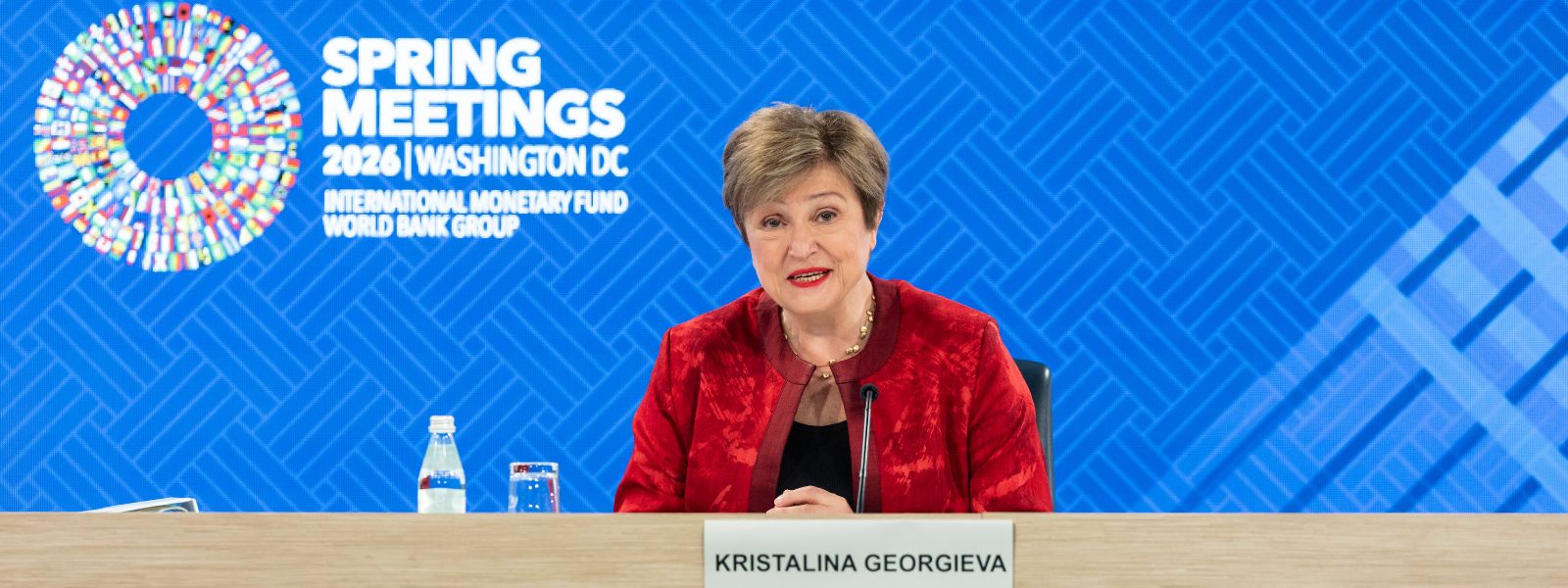
COLOMBO (News 1st); Tough times may lie ahead for the global economy if the conflict in the Middle East persists and keeps oil prices high, International Monetary Fund Managing Director Kristalina Georgieva has warned, highlighting growing risks to growth, public finances, and vulnerable economies.
Speaking on the evolving situation, Georgieva said the war has already caused “significant pain” for people and economies both in the Middle East and around the world.
She expressed hope that the current ceasefire would lead to a durable peace, but cautioned that the economic fallout is already being felt globally.
According to the IMF chief, even if the conflict proves short-lived, widespread infrastructure damage and supply-chain disruptions are pushing prices higher and slowing global growth. She said global growth is now expected to ease from 3.4 percent last year to 3.1 percent in 2026.
However, Georgieva warned that a prolonged conflict accompanied by sustained high oil prices would significantly worsen the outlook. Referring to the IMF’s World Economic Outlook, she said that in the most adverse scenario, global growth could slow to 2 percent, with the shock affecting all countries.
“All countries are affected by higher energy prices,” she said, noting that while the impact is global, it is far from even. The heaviest burden, she explained, falls on countries that import energy and have limited room to respond through policy measures. In many cases, these are low-income or fragile economies, which require special attention and support.
Georgieva said that in a world marked by frequent shocks and uncertainty, the immediate priority must be the preservation of macroeconomic and financial stability. While it is understandable that governments want to support businesses and households affected by external supply shocks, she urged caution.
“Look before you leap,” she said.
On monetary policy, Georgieva advised that countries with well-calibrated policies prior to the shock and anchored expectations should adopt a “wait and see” approach, while others may need to respond earlier depending on their circumstances.
Turning to fiscal policy, she stressed that high public debt is now a major constraint on governments worldwide. Unlike during the COVID-19 crisis, she said, the current challenge is the cumulative impact of shock after shock, which has pushed debt levels to dangerous heights.
Global public debt, Georgieva warned, is projected to breach 100 percent of world GDP by 2029, a level not seen since the aftermath of World War II.
To preserve fiscal credibility, she said policymakers must carefully balance the need to maintain fiscal sustainability with protecting those who are hardest hit and least able to cope. She welcomed the fact that many countries have avoided broad, untargeted measures such as generalized tax cuts, energy subsidies, and price controls.
However, she expressed concern that some governments are turning to untargeted measures, export controls, and broad-based tax cuts.
While often well-intentioned, she warned that such policies tend to prolong periods of high prices rather than resolve them.
Georgieva also cautioned against losing sight of longer-term forces shaping the global economy, including geopolitics, trade dynamics, technology, demographic shifts, and climate change. She called on policymakers to accelerate growth-oriented structural reforms, stressing that stronger productivity and growth provide the best protection against future shocks.
“A strong economy is the best buffer,” she said, adding that once the current shock passes, countries will need to rebuild policy space to better prepare for the challenges ahead.
Other Articles
-835253_550x300.jpg)

-835241_550x300.jpg)

-835229_550x300.jpg)





Featured News


News 1st, MTV Channel (Pvt) Ltd, MBC Networks (Pvt) Ltd, 45/3, Braybrooke Street, Colombo-02.
T.P : +94 114 792 700,
Fax : +94 114 792 733
T.P : +94 114 792 700,
Fax : +94 114 792 733




 |  |  |
|---|---|---|
 |  |  |
 |  |  |
 |

.gif)