.webp)


First Israel, Lebanon Leader Communication in 34 Years



.png )
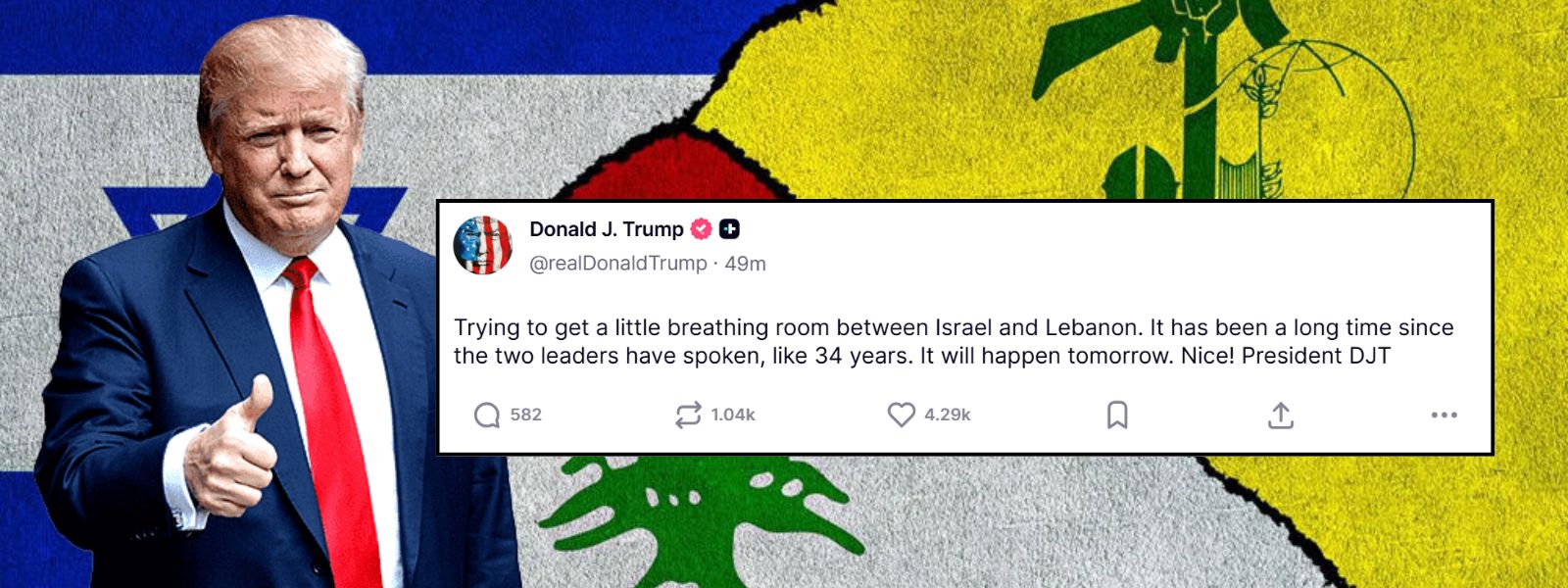
COLOMBO (News 1st); US President Donald Trump has said efforts are underway to create “a little breathing room” between Israel and Lebanon, announcing that the two countries’ leaders are set to speak for the first time in more than three decades.
In a post on his social media platform, Truth Social, Trump said it has been 34 years since the leaders of Israel and Lebanon last spoke directly. According to his post, that long gap in communication is expected to end tomorrow.
“Trying to get a little breathing room between Israel and Lebanon. It has been a long time since the two leaders have spoken, like 34 years. It will happen tomorrow. Nice!” Trump wrote.
Trump did not provide further details about the nature of the discussions, how they will take place, or what issues will be addressed.
The two countries have had a rocky and often hostile relationship since Israel's inception in 1948. Like the majority of Arab countries, Lebanon has no formal diplomatic relations with Israel, and a 1955 law in Lebanon forbids Lebanese citizens from having any contact with Israelis — although the law is selectively enforced.
On March 2, two days after the U.S. and Israel launched their war on Iran, Hezbollah entered the fray by firing missiles across the border. Israel responded with an intense bombing campaign and ground invasion.
Lebanon's current government came to power in early 2025 on a reformist platform that included disarming non-state actors. Officials were angered by Hezbollah's decision to enter a new war. The government moved to criminalize the group's military activities, declared Iran's ambassador persona non grata, and banned the Iranian Revolutionary Guard.
President Joseph Aoun offered direct negotiations with Israel — the first in decades — in exchange for a cessation of hostilities. Neither Israel nor the Americans responded. French President Emmanuel Macron backed Aoun, but even then, the calls fell on deaf ears.
That changed after the announcement of a truce between Iran and the United States and talks between the two brokered by Pakistan.
Tehran included as a condition for permanent ceasefire that the cessation of hostilities should include Lebanon. Though Pakistan said it was part of the agreement, Israel dismissed Lebanon's inclusion in the ceasefire, and Washington later followed suit.
The Lebanese state, meanwhile, had reservations about Lebanon being a card in the Iranian negotiations and wanted to separate the war in Lebanon into its own diplomatic track.
Hezbollah and its supporters said that, given Lebanon's weak position, Beirut should rely on Tehran's leverage and not directly negotiate with Israel while under fire. The group accused the government of offering "free concessions" to an enemy state.
After Israel launched over 100 airstrikes in Lebanon, including in some of the busiest areas in the heart of Beirut killing over 350 people, on April 8 Prime Minister Benjamin Netanyahu announced that he had agreed to direct talks with Lebanon.
Other Articles






Featured News




News 1st, MTV Channel (Pvt) Ltd, MBC Networks (Pvt) Ltd, 45/3, Braybrooke Street, Colombo-02.
T.P : +94 114 792 700,
Fax : +94 114 792 733
T.P : +94 114 792 700,
Fax : +94 114 792 733




 |  |  |
|---|---|---|
 |  |  |
 |  |  |
 |

.gif)