.webp)


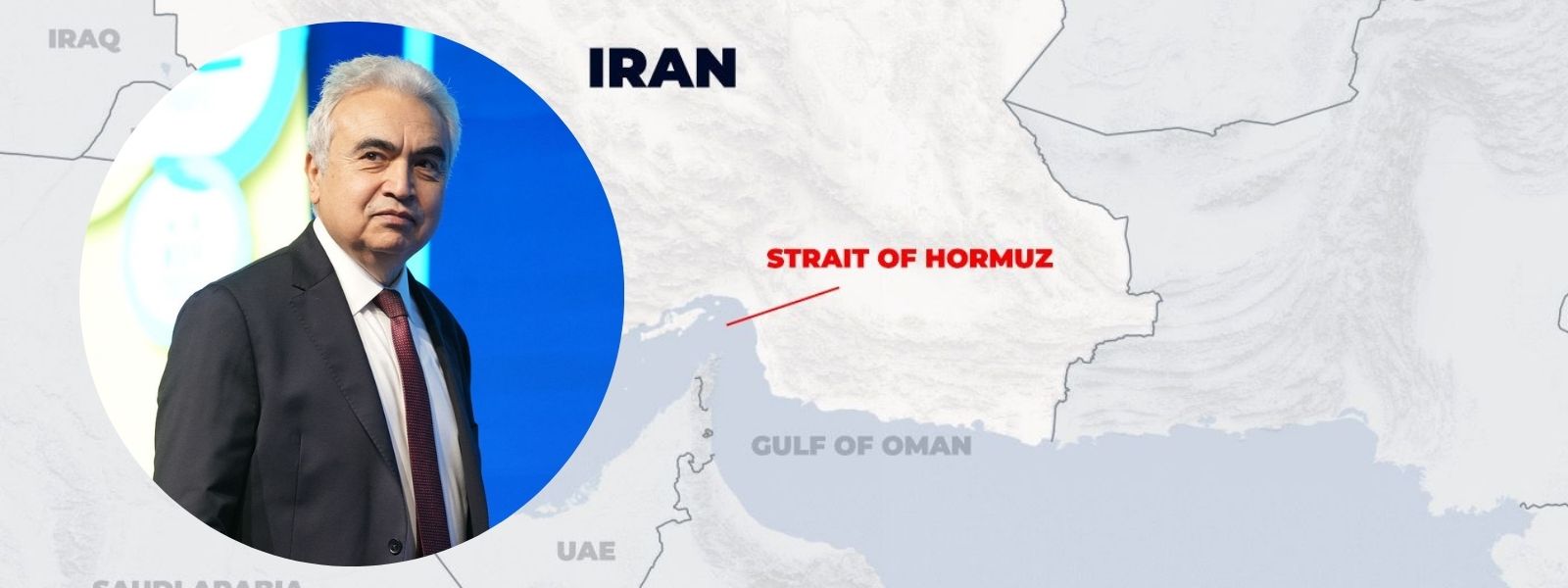
Global Economy Facing Combined Oil and Gas Shock, Says IEA Director



.png )
COLOMBO (News 1st); The global energy supply situation linked to disruptions in the Strait of Hormuz is “very severe” and significantly worse than many decision-makers fully appreciate, according to International Energy Agency (IEA) Executive Director Dr. Fatih Birol.
“To put it very frankly, the situation is very severe,” Dr. Birol said. “I thought the depth of the problem was not well appreciated by the decision makers around the world.”
Dr. Birol compared the current disruption to the historic oil shocks of the 1970s. During the 1973 and 1979 oil crises, the world lost approximately five million barrels of oil per day in each crisis, for a combined total of ten million barrels per day. Those disruptions were followed by major economic turmoil and global recessions.
“Today, as of today, we lost 11 million barrels per day,” he said. “So more than two major oil shocks put together.”
Beyond oil, Dr. Birol highlighted the unprecedented impact on natural gas markets, particularly in Europe. Following Russia’s invasion of Ukraine, Europe initially lost about 75 billion cubic meters (BCM) of gas supply. As the current crisis has deepened, total gas supply losses have now reached approximately 140 BCM, nearly double the earlier shortfall.
“If you want to put this crisis in context,” he said, “as it stands now, it is two oil crises and one gas crisis put all together.”
Dr. Birol also warned that the impact extends far beyond oil and gas alone. Several critical components of the global economy have been disrupted, including petrochemicals, fertilizers, sulfur, and helium. He said interruptions in the trade of these vital materials could have serious and far-reaching consequences for the global economy.
“These are some of the vital arteries of the global economy,” he said. “Their trade is all interrupted, which would have serious consequences.”
When asked about political developments, including a public ultimatum issued by U.S. President Donald Trump to Iran demanding the reopening of the Strait of Hormuz or facing further attacks on infrastructure, Dr. Birol declined to comment on political or military matters.
“I will not make any political or military comments,” he said. Instead, Dr. Birol outlined the steps taken by the International Energy Agency to stabilize global markets. On March 11, the IEA coordinated the release of 400 million barrels of oil, the largest release in the agency’s history. The decision was taken unanimously by all IEA member countries.
“We have never released so much oil to the markets,” he said, describing the move as difficult but necessary.
Following the announcement, oil prices fell by $18 per barrel, offering temporary relief. However, prices rose again after renewed bombings and escalating tensions.
In addition to supply-side interventions, the IEA has also introduced demand-side measures aimed at reducing energy consumption in order to limit economic damage.
“What we are doing is, to be very frank, to reduce the pain on the economy,” Dr. Birol said.
Despite these efforts, he stressed that technical measures alone cannot fully resolve the crisis. According to the IEA chief, the most critical and effective solution remains restoring safe passage through one of the world’s most important energy chokepoints.
“The single most important solution to this problem,” Dr. Birol said, “is opening up the Hormuz Strait.”
Other Articles



-832160_550x300.jpg)





Featured News



News 1st, MTV Channel (Pvt) Ltd, MBC Networks (Pvt) Ltd, 45/3, Braybrooke Street, Colombo-02.
T.P : +94 114 792 700,
Fax : +94 114 792 733
T.P : +94 114 792 700,
Fax : +94 114 792 733




 |  |  |
|---|---|---|
 |  |  |
 |  |  |
 |

.gif)