.webp)


Sri Lanka Meteorologists Debunk Ditwah Myths



.png )
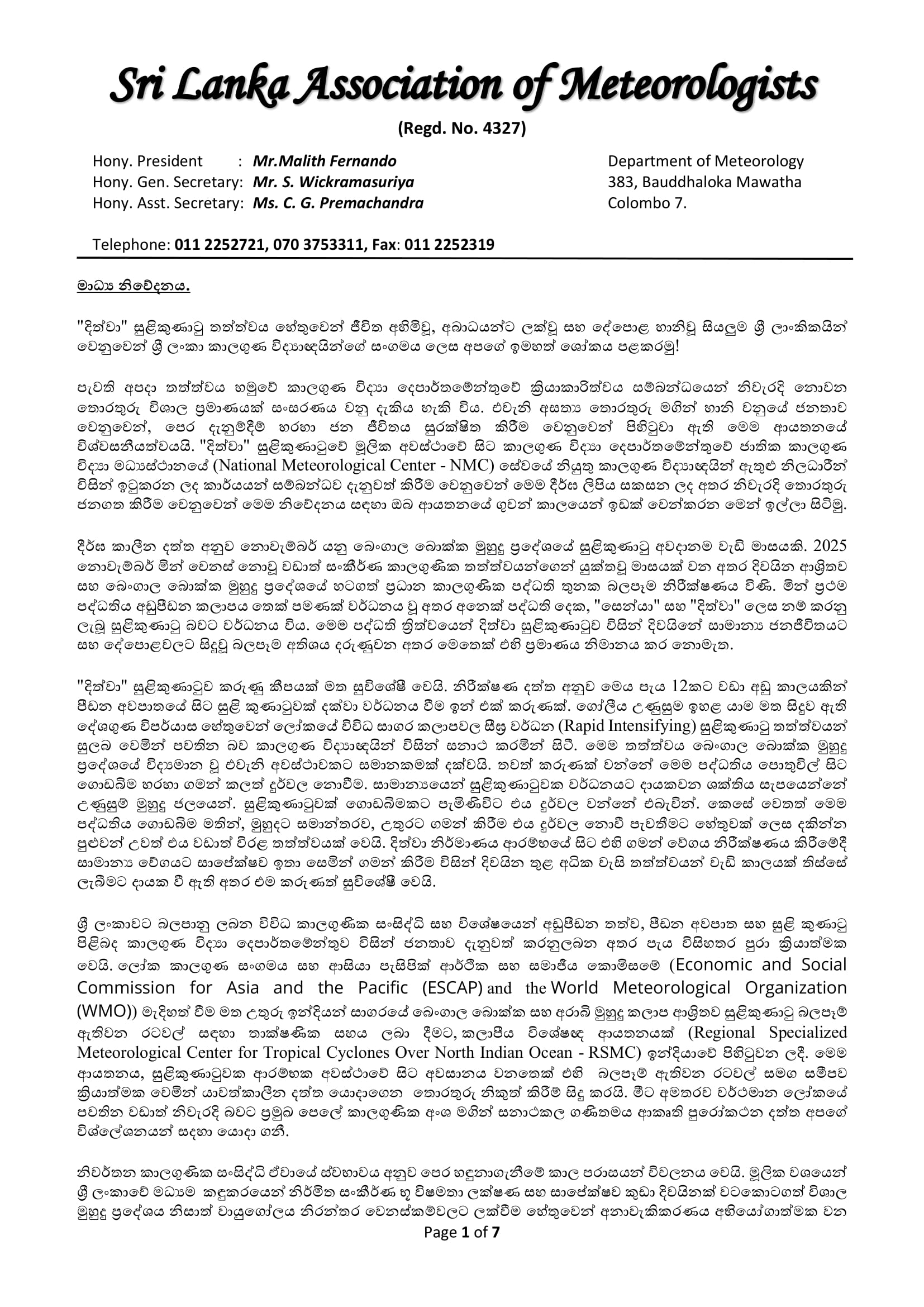
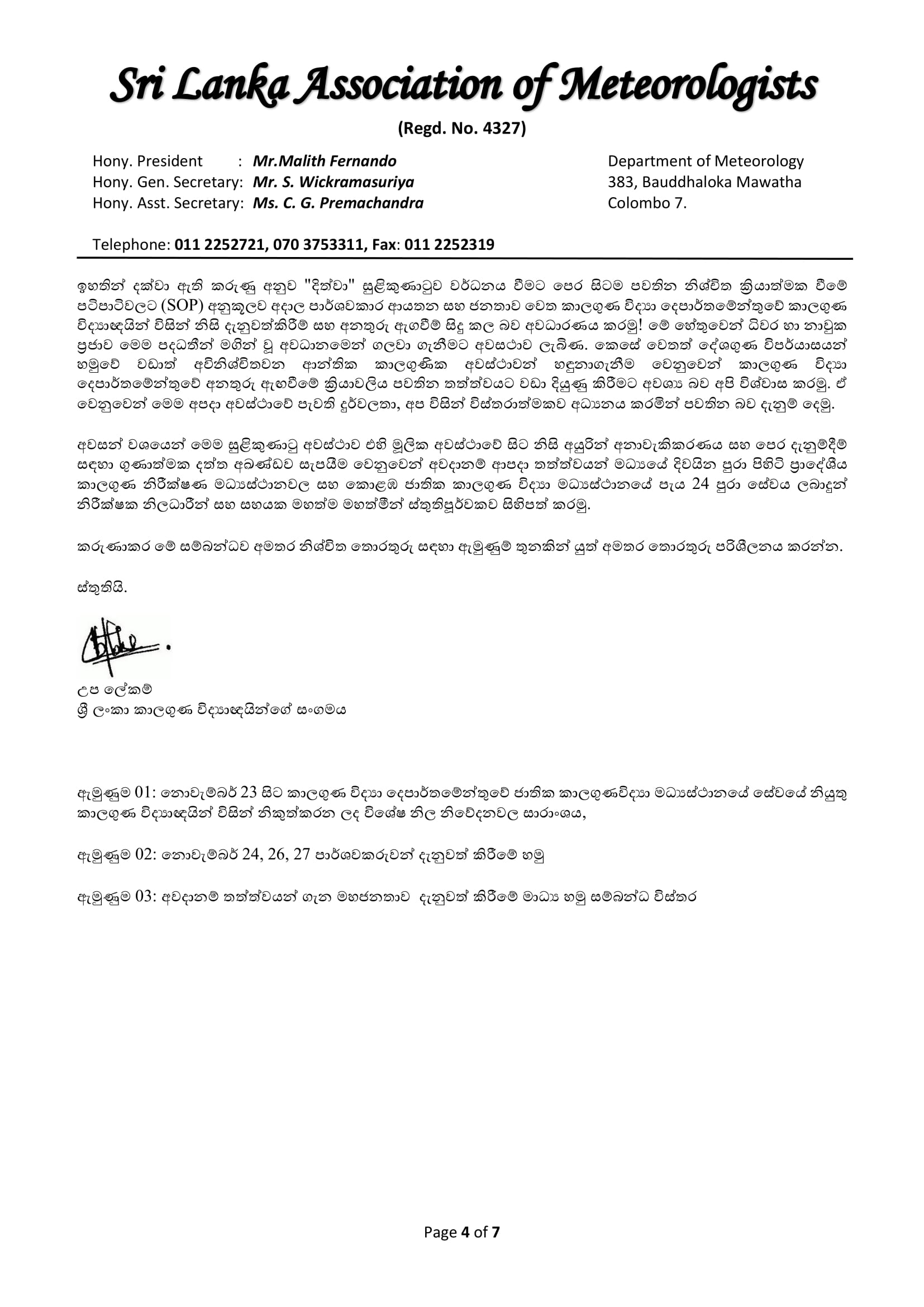
COLOMBO (News 1st); The Sri Lanka Association of Meteorologists has issued a media statement addressing questions and criticisms raised after Cyclone Ditwah, regarding weather forecasts, warnings, and the timing of alerts.
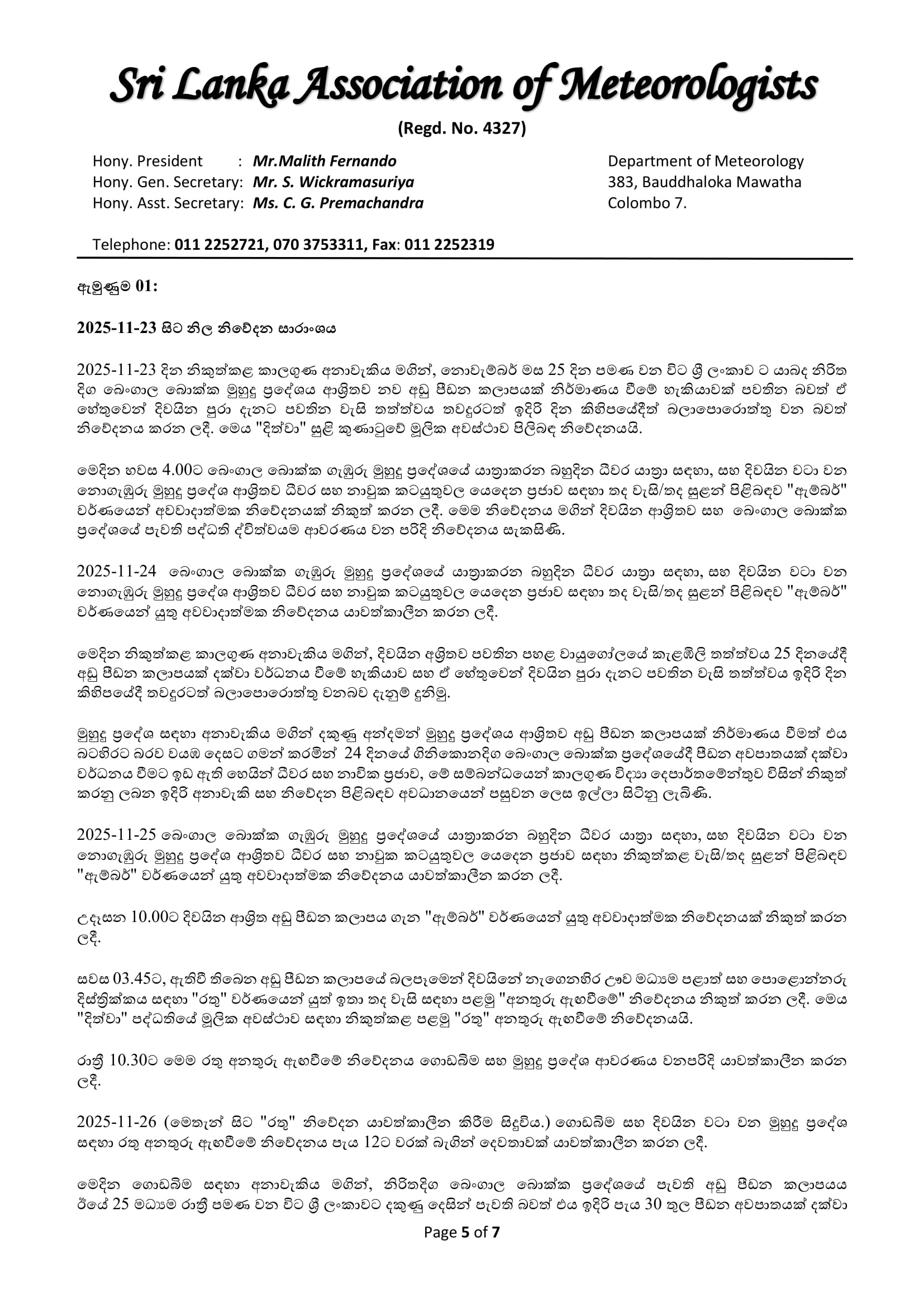
According to the statement, the atmospheric disturbance that led to the formation of Cyclone Ditwah was first identified by Sri Lankan scientists on November 23.
On the same day, information was promptly shared with fishing and naval communities, warning that a low-pressure area could develop near the island by November 25.
The statement further notes that on November 24, warnings were updated with the latest data from the Malacca Strait, and stakeholders were informed about evolving weather conditions.
Confirming earlier alerts, the Association states that a low-pressure area formed on November 25, and at 10:00 a.m., an Amber advisory was issued for the low-pressure zone near Sri Lanka.
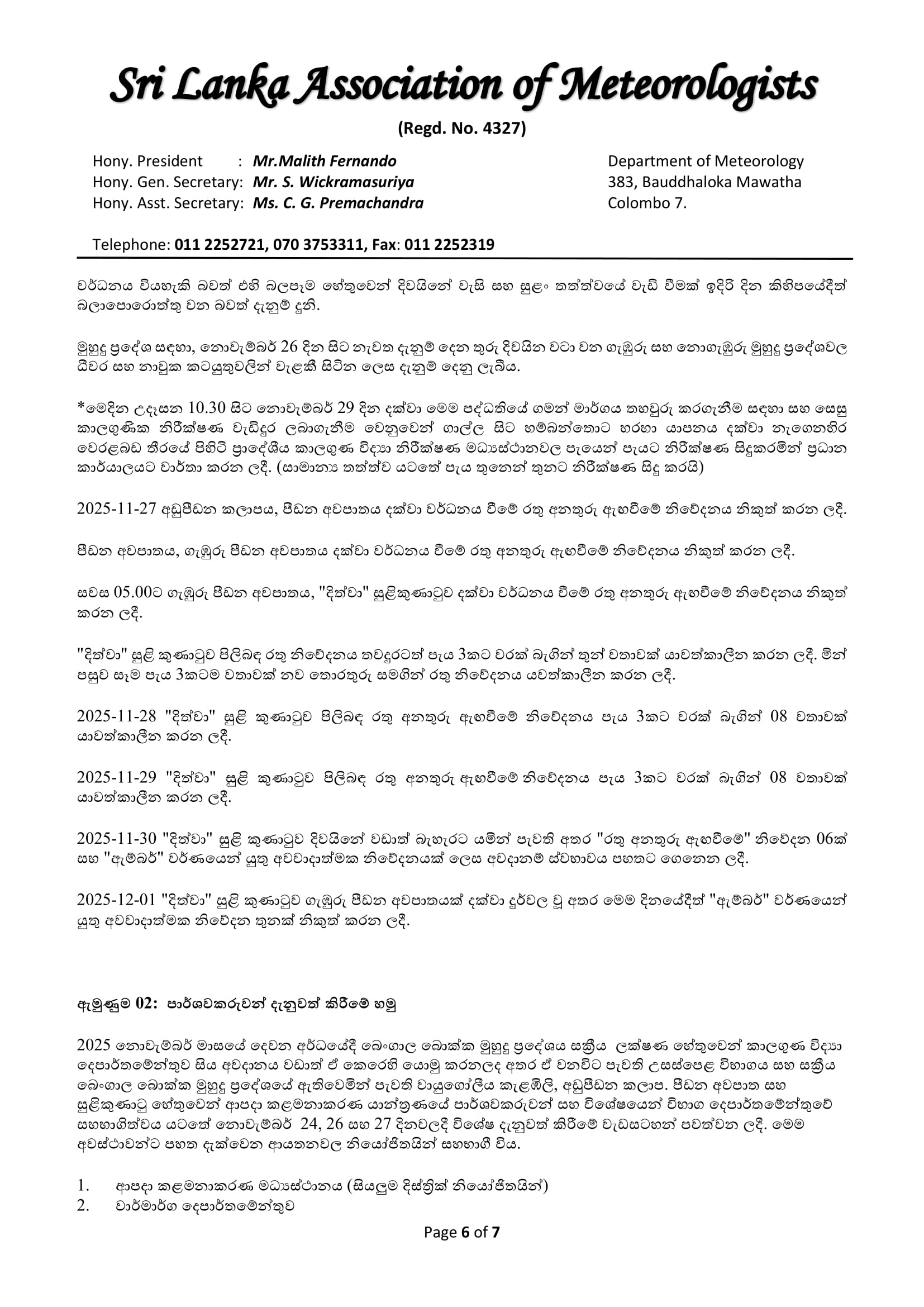
Later that day, at 3:45 p.m., a Red warning for heavy rainfall was released—the first such alert linked to the initial stage of the Ditwah system.
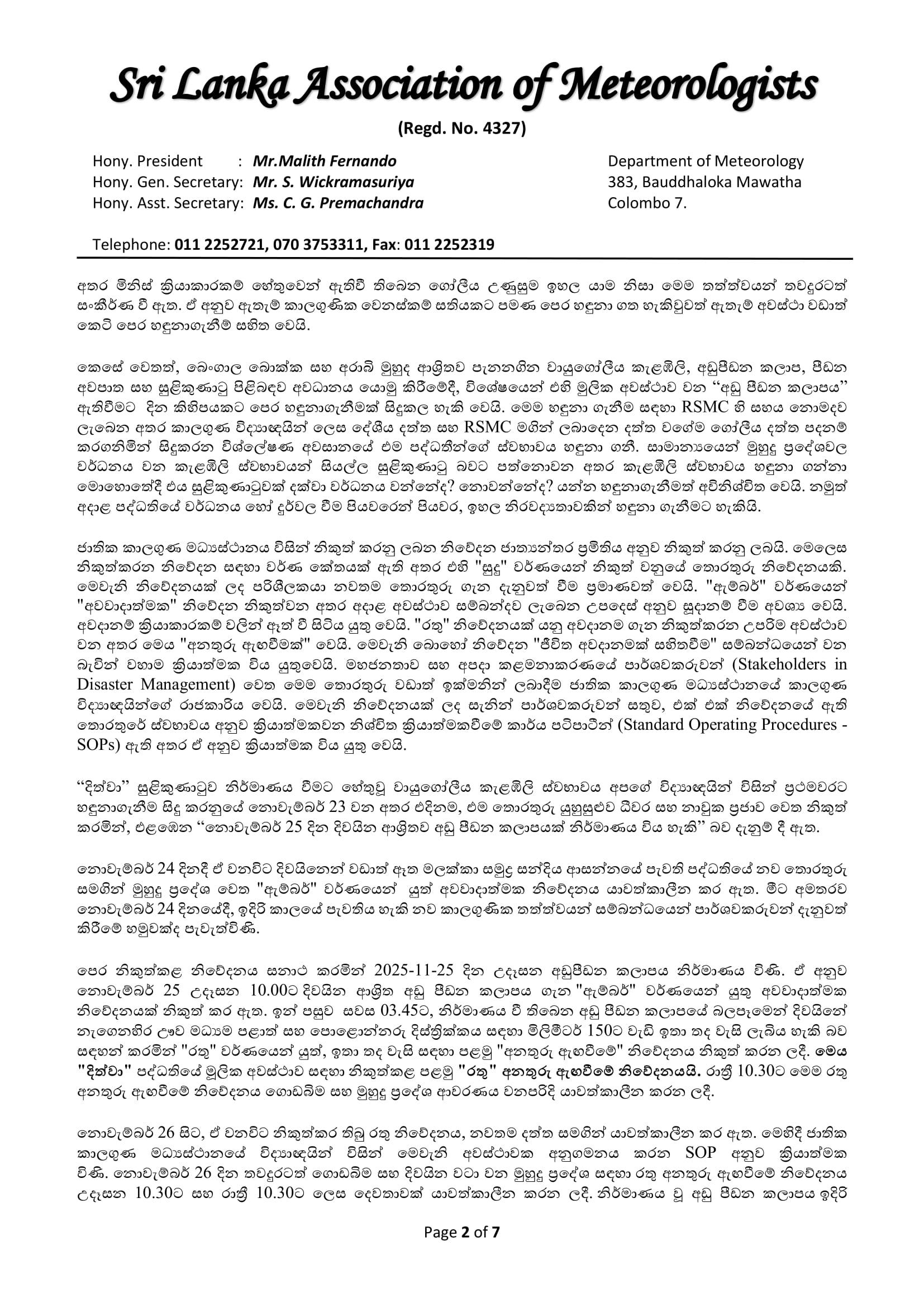
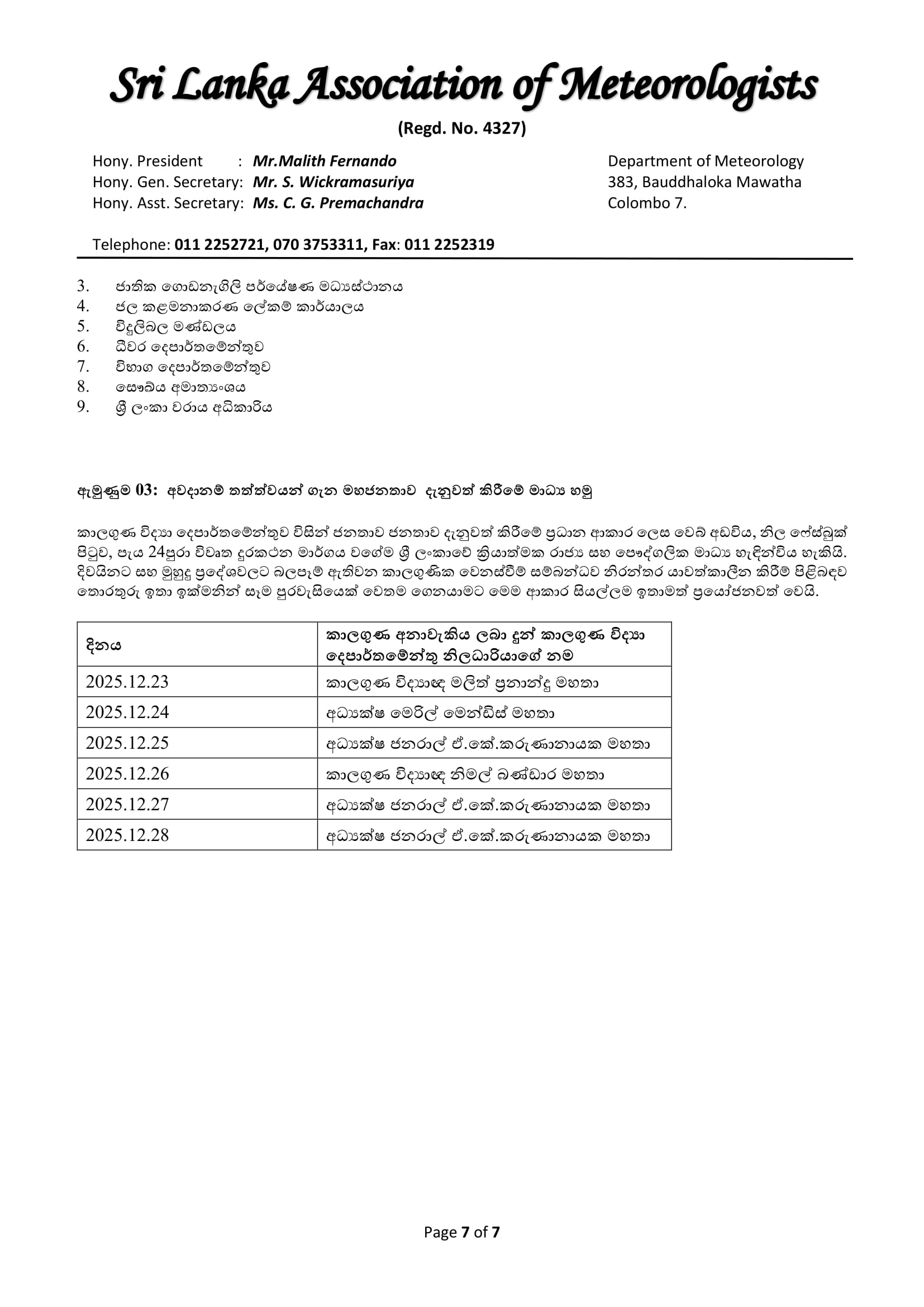
From that point onward, warnings were issued continuously, with 25 Red alerts updated through November 30, alongside three stakeholder briefing sessions during the period.
The statement also responds to criticisms about forecast accuracy.
It highlights two main allegations:
BBC reportedly forecast 500 mm of rainfall on November 25, while Sri Lanka’s Meteorology Department predicted 150 mm per day.
The Indian Meteorological Department (IMD) issued warnings about Ditwah as early as November 13.
Extracted Quote:
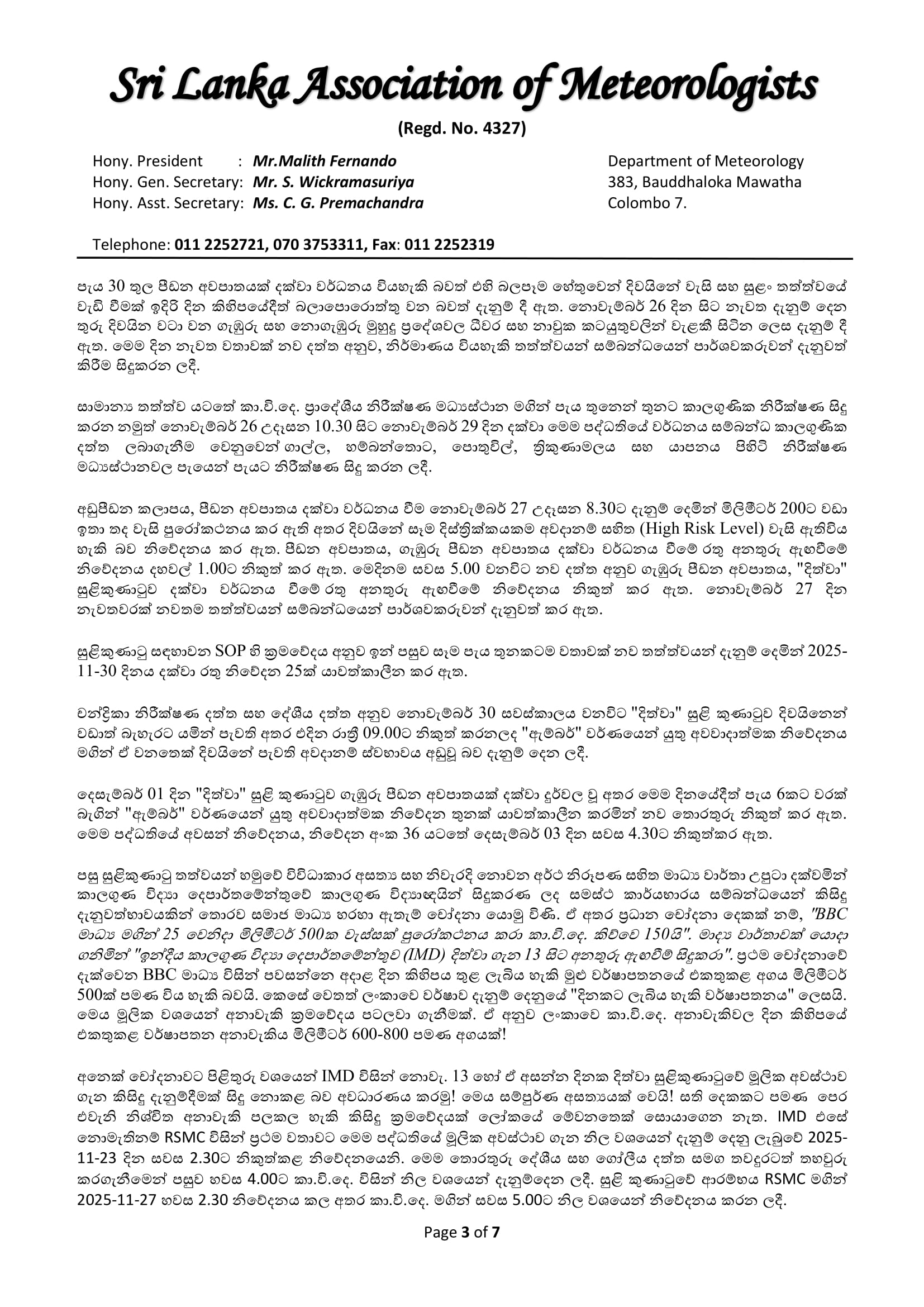
“In Sri Lanka, rainfall forecasts are communicated as ‘expected daily precipitation’, which is a fundamental forecasting methodology.
Based on this approach, the cumulative rainfall forecast for several days during Cyclone Ditwah was approximately 600–800 mm.
In response to another allegation, we emphasize that the Indian Meteorological Department (IMD) did not issue any warning about the initial stage of Cyclone Ditwah on or around November 13.
This claim is entirely false.
Globally, there is currently no system capable of issuing precise cyclone forecasts two weeks in advance.
The IMD did not provide such early alerts.
The Regional Specialized Meteorological Centre (RSMC) officially announced the initial stage of the system on November 23 at 2:30 p.m.
After verifying this information with local and global data, Sri Lanka’s Department of Meteorology issued its official advisory at 4:00 p.m.
The cyclone’s formation was confirmed by the RSMC on November 27 at 2:30 p.m., followed by Sri Lanka’s official announcement at 5:00 p.m.”
Other Articles
-842226_550x300.jpg)
-842220_550x300.jpg)
-842214_550x300.jpg)
-842208_550x300.jpg)
-722285-839254_850x460-842202_550x300.jpg)
-842195_550x300.jpg)




Featured News


-835300_550x300.jpg)


News 1st, MTV Channel (Pvt) Ltd, MBC Networks (Pvt) Ltd, 45/3, Braybrooke Street, Colombo-02.
T.P : +94 114 792 700,
Fax : +94 114 792 733
T.P : +94 114 792 700,
Fax : +94 114 792 733




 |  |  |
|---|---|---|
 |  |  |
 |  |  |
 |

.gif)