


Can Sri Lanka Be the Granary of the East Again? New ‘10 Plus’ Rice Challenge Begins



.png )
COLOMBO (News 1st); For centuries, Sri Lanka carried the reputation of being the "Granary of the East", a land whose agricultural strength sustained kingdoms and communities alike.
Yet today, while the country remains self-sufficient in rice production, it continues to rely heavily on imports for many other grain-based food commodities. Against that backdrop, a new challenge aimed at transforming agricultural productivity while rethinking the future direction of farming in Sri Lanka was launched in Polonnaruwa.
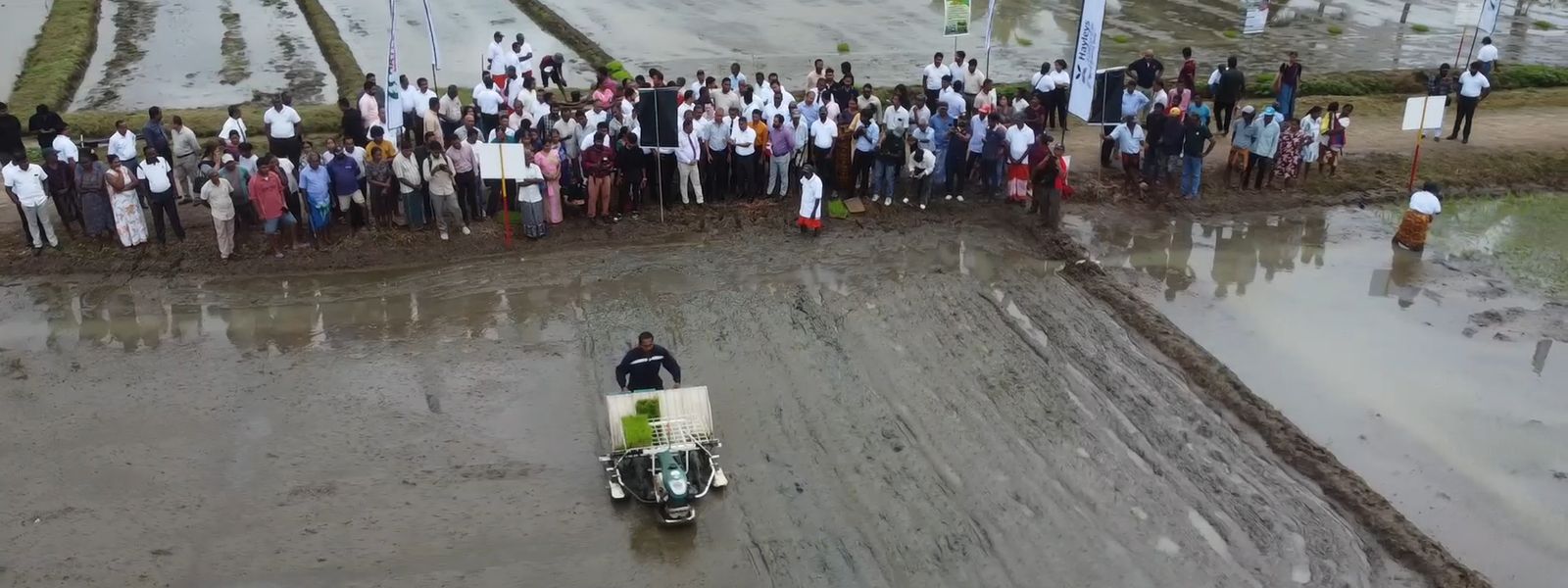
The Department of Agriculture's Super Paddy Yaya - Ten Plus Rice Cultivation Programme was officially launched at the Hingurakdamana LPO 21 paddy field in Gal Amuna.
The initiative has set an ambitious target of producing more than 10 metric tonnes of paddy per hectare, a benchmark that, if achieved consistently, would place participating cultivators among the highest-yielding rice producers in the country.
A standout feature of the programme is the introduction of a specialised technical package consisting of 11 scientifically recommended cultivation practices developed by the Department of Agriculture. The package is expected to guide farmers through every stage of cultivation, from land preparation and crop establishment to nutrient management and harvesting, with the objective of pushing productivity beyond conventional levels.
The programme has also brought together an unusually broad coalition of partners. Farmers, university agriculture faculties, the Department of Agriculture, the Department of Agrarian Development, private sector companies and other agricultural stakeholders have all been enlisted to take part in what is effectively a national cultivation challenge.
Addressing the launch, Agriculture Minister K.D. Lal Kantha described the programme as a field-based experiment designed to test the capabilities of both public and private sector participants under real farming conditions.
"Ten companies and eleven paddy fields are involved in this initiative. What we wanted was to bring together farmers, the agriculture faculties of our universities, the Department of Agriculture, the Department of Agrarian Development and all other relevant stakeholders. We wanted to take this challenge directly to the field and put it before them.
"At this point, the companies actually have a greater challenge than we do. They cannot afford to fail. Even if we fail and go home, the real question is which company can deliver the highest yield from its field. In that sense, we have created a very interesting challenge.
"At the same time, we have made it clear that if farmers suffer a reduction in yield because of the work carried out under this programme, those companies must compensate the farmers. The farmers must be compensated. We cannot allow farmers to suffer any losses."
The minister said the programme was not merely about increasing yields but also about confronting larger questions surrounding the long-term sustainability of Sri Lanka's agricultural sector.
Reflecting on the country's agricultural heritage, Lal Kantha said the term "Granary of the East" carried a meaning that extended far beyond rice cultivation alone.
"And since we are in Polonnaruwa, it would not be right not to mention King Parakramabahu. At times like this, we must remember that this country was known as the Granary of the East, not simply the Paddy Storehouse of the East or anything similar. Everyone should remember that when we speak of grain, we are not talking only about paddy.
"If we consider the true meaning of being the Granary of the East, then as a nation we have failed. Today, apart from rice, we import almost all other grain-based food commodities from abroad for consumption."
While reaffirming that Sri Lanka has achieved adequate rice production, the minister argued that the future of agriculture would require a gradual but deliberate diversification away from excessive dependence on paddy cultivation.
"We already produce enough rice. We have enough. Whether people like it or not, we will inevitably have to reduce a significant portion of our paddy cultivation.
"If we do not reduce at least one-third of the paddy lands currently under cultivation in the near future, our farmers, our agricultural sector and the country's economy will face a serious crisis. Therefore, we must move towards other crops. That shift cannot be avoided."
Lal Kantha also challenged long-held assumptions about the economic value of maintaining vast areas under paddy cultivation, questioning whether generations of rice farming had translated into broader agricultural prosperity.
"How many seasons have passed? How many generations have cultivated paddy? Have we won the economic battle? Have we become stronger? No. Therefore, if possible, let us move towards a programme where half of our paddy lands are used for supplementary and alternative crops. Let half go towards other crops."
The Super Paddy Yaya - Ten Plus Rice Cultivation Programme now begins as more than a contest for higher yields. It is emerging as a test of whether Sri Lankan agriculture can simultaneously achieve record harvests, protect farmer incomes and chart a new path toward a more diversified farming economy, while revisiting the broader vision that once earned the country its reputation as the Granary of the East.
Other Articles






Featured News




News 1st, MTV Channel (Pvt) Ltd, MBC Networks (Pvt) Ltd, 45/3, Braybrooke Street, Colombo-02.
T.P : +94 114 792 700,
Fax : +94 114 792 733
T.P : +94 114 792 700,
Fax : +94 114 792 733




 |  |  |
|---|---|---|
 |  |  |
 |  |  |
 |

