.webp)


IMF Warns Global Economy's Resilience Is Reaching Its Limit



.png )
COLOMBO (News 1st); The global economy remains resilient despite mounting geopolitical tensions and rising energy prices, but the International Monetary Fund (IMF) has warned that the foundations of that resilience are increasingly coming under strain as the world confronts a combination of war-driven inflation, elevated debt levels and growing economic uncertainty.
Presenting the IMF's latest World Economic Outlook 2026: Resilience Under Strain, Urgent Choices, Silvana Tenreyro, Economic Counsellor and Director of the IMF's Research Department, said global growth is projected at 3.1% in 2026, down from the previous year, before rising modestly to 3.4% in 2027.
According to the IMF, the outlook is being shaped by two powerful and competing forces.
The first is the surge in energy and commodity prices triggered by conflict in the Middle East, which is acting as a negative global supply shock by increasing costs and slowing economic activity. The second is the continuing technology boom, driven largely by artificial intelligence, which is supporting investment, trade and economic expansion across a number of economies.
While these forces are pulling growth in opposite directions, the IMF noted that both are contributing to higher inflation. Global headline inflation is projected to rise to 4.7% this year before easing to 4.1% in 2027, while core inflation is expected to remain elevated.
The IMF warned that the benefits of growth are being distributed unevenly. Countries that export energy and economies deeply integrated into the artificial intelligence supply chain are expected to perform relatively well. In contrast, energy-importing economies and countries with limited participation in the AI-driven technology boom face weaker growth prospects and greater vulnerability to external shocks.
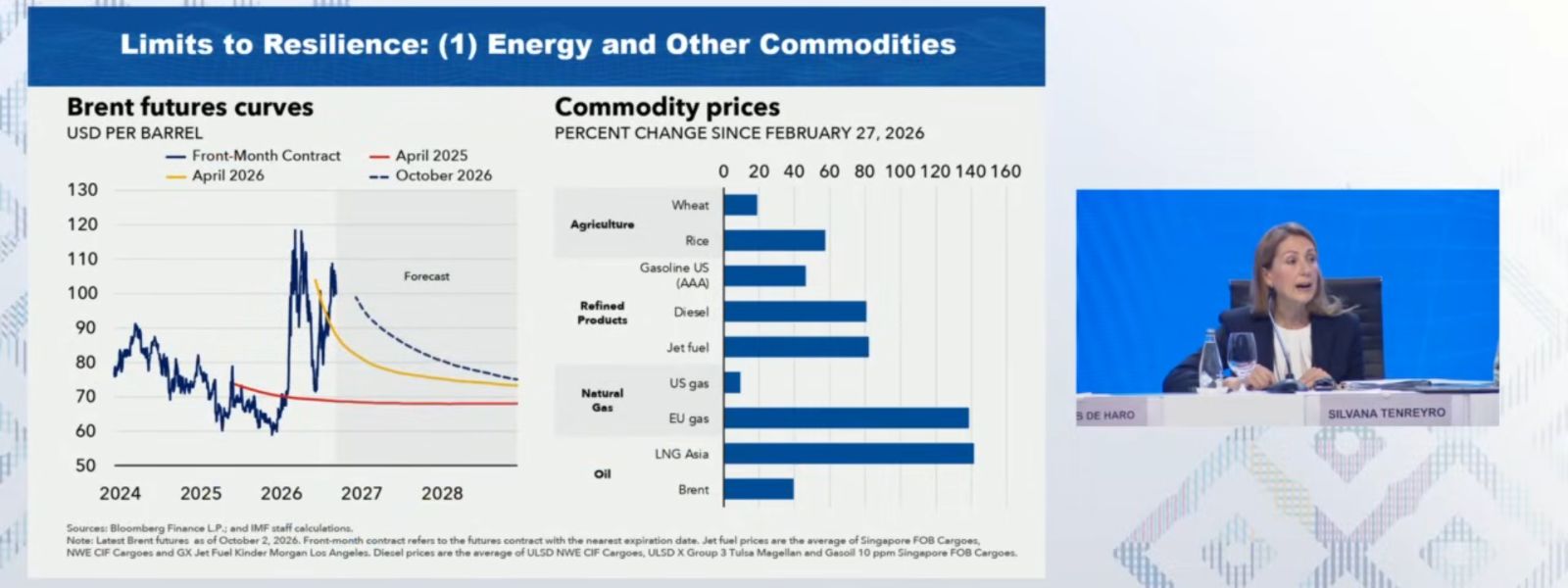
A particular concern for the Fund is the renewed escalation of tensions in the Middle East, which has pushed up prices for crude oil, natural gas and refined fuel products, including diesel and jet fuel. Tenreyro cautioned that any prolonged disruption to energy production or transportation routes in the region could result in even higher commodity prices and place additional pressure on the global economy.
She noted that global energy markets have so far been cushioned by a range of adjustment mechanisms, including the rerouting of supplies, increased production elsewhere, the use of inventories, greater reliance on renewable energy and improvements in energy efficiency. According to the IMF, without these mitigating factors, global growth this year would have been significantly lower than currently projected.
Providing further insight into the regional impact of the conflict, Petya Koeva Brooks, Deputy Director of the IMF's Research Department, said the economic consequences of the Middle East crisis vary considerably between oil-exporting and oil-importing countries. She revealed that the IMF revised its forecasts shortly before publication to account for higher oil prices and noted that risks remain skewed to the downside.
Brooks said oil-exporting economies, particularly in the Gulf region, are expected to experience a contraction in production and export activity in the near term, followed by a recovery in 2027, assuming current projections hold. Some oil-exporting countries are also beginning to experience slower growth in non-energy sectors.
For oil-importing economies, however, the picture is somewhat different. The IMF has modestly upgraded growth expectations for many of these countries, supported by continued strength in domestic demand, tourism and remittance inflows. Nevertheless, the Fund stressed that these economies remain exposed to further increases in energy prices and broader geopolitical instability.
Beyond energy markets, the IMF also highlighted risks associated with the concentration of AI-related supply chains in a small number of countries and firms. While artificial intelligence has become a major contributor to global investment and productivity growth, the Fund warned that supply bottlenecks, cybersecurity vulnerabilities and potential corrections in technology-related markets could pose new risks to financial stability and growth.
The IMF additionally cautioned that rising borrowing costs are becoming an increasing concern for highly indebted governments. Higher debt-servicing burdens could crowd out essential public spending and reduce governments' ability to respond effectively to future crises. A scenario combining elevated commodity prices and heightened concerns about public debt sustainability would result in weaker growth and higher inflation across both advanced and emerging economies.
Against this backdrop, the Fund called for disciplined fiscal and monetary policies, stronger financial safeguards and continued efforts to build resilience against future shocks. The IMF urged governments to rebuild fiscal buffers, preserve central bank independence, strengthen supply chains and support long-term productivity growth.
Summarising the IMF's assessment, Tenreyro said the world economy has repeatedly demonstrated resilience in recent years, but warned that many of the buffers that helped absorb previous shocks are now being stretched.
"The economy has been resilient, but that resilience is reaching its limits," she said, calling on policymakers to shift their focus from crisis management toward rebuilding economic strength and laying the foundations for sustainable long-term growth.
Other Articles










Featured News




News 1st, MTV Channel (Pvt) Ltd, MBC Networks (Pvt) Ltd, 45/3, Braybrooke Street, Colombo-02.
T.P : +94 114 792 700,
Fax : +94 114 792 733
T.P : +94 114 792 700,
Fax : +94 114 792 733




 |  |  |
|---|---|---|
 |  |  |
 |  |  |
 |

.gif)