.webp)


What Exactly Was the Threat? Govt Challenges BASL Claim



.png )
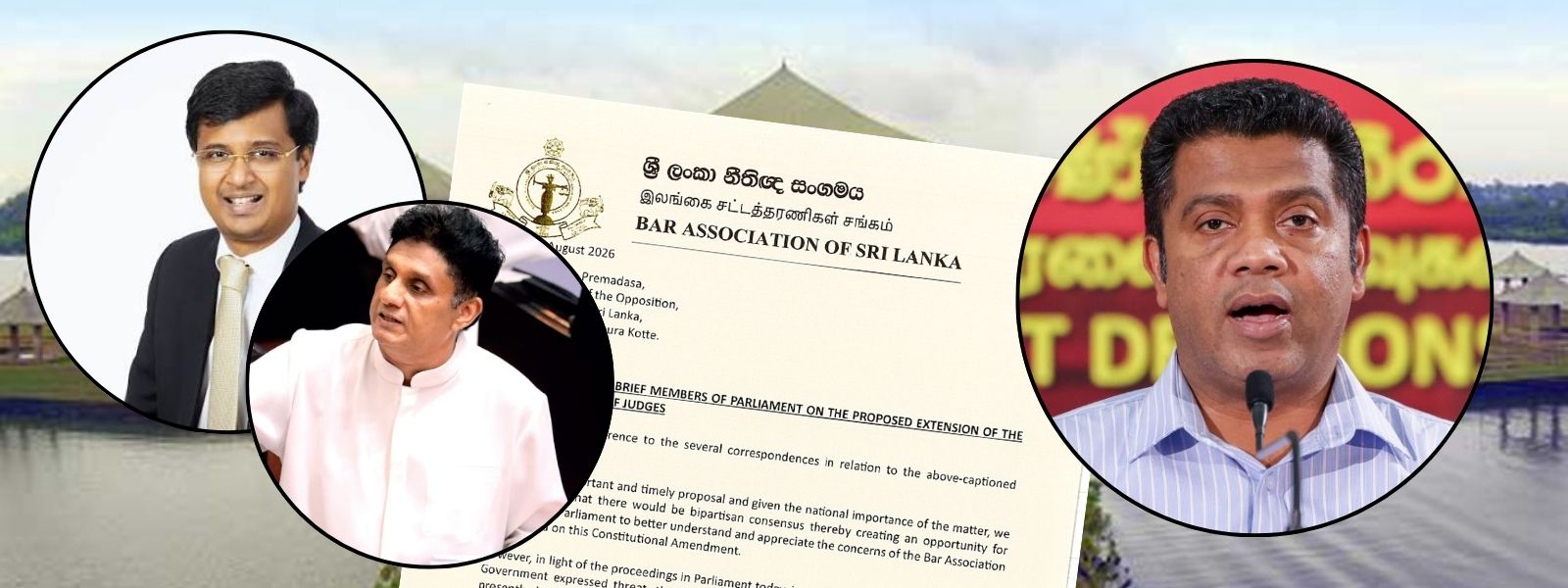
COLOMBO (News 1st); A heated debate unfolded in Parliament after the Government challenged a statement contained in a letter issued by the Bar Association of Sri Lanka (BASL), which cited a "position of the Government expressed threat" as a reason for postponing a proposed briefing for Members of Parliament.
The controversy stems from a letter sent by BASL President Rajeev Amarasuriya to Opposition Leader Sajith Premadasa regarding a planned session intended to brief all 225 Members of Parliament on issues including the proposed 22nd Constitutional Amendment and matters concerning appointments to the higher judiciary.
In the letter dated August 19, the BASL described the proposed briefing as an important and timely initiative and noted that, given the national importance of the matter, it had hoped there would be bipartisan consensus so that MPs could better understand the concerns raised by the legal profession.
However, the letter stated that "in light of the proceedings in Parliament today, i.e. 19.08.2026, and the position of the Government expressed threat," there appeared to be no consensus or interest from the Government in providing such an opportunity to its Members of Parliament. While acknowledging that the Opposition had already expressed strong objections to the proposed constitutional amendment, the BASL maintained that such a briefing would have been particularly useful for Government MPs to objectively consider their position. The association therefore requested that the session be postponed until bipartisan participation could be assured, while thanking Premadasa for what it described as a progressive initiative in the constitutional debate.
Raising the matter in Parliament, Minister Dr. Nalinda Jayatissa questioned the use of the word "threat" and challenged the basis upon which the BASL President had characterized the Government's position in that manner.
Jayatissa argued that comments made by the Leader of the House during the previous day's debate had merely outlined parliamentary procedures, conventions and the proper process for convening all Members of Parliament. According to the Minister, Members routinely express different opinions during parliamentary debates and no threats of any kind had been made.
The Minister asked how a discussion on parliamentary procedure could be interpreted as a threat and whether describing it as such was consistent with parliamentary traditions and representative democracy. He maintained that neither the Government nor the Leader of the House had engaged in any threatening conduct and said the issue should be brought to the attention of Parliament.
Responding, Opposition Leader Sajith Premadasa rejected suggestions that the proposed session had been a personal invitation from him. He emphasized that he had merely requested that the Speaker facilitate the participation of all 225 MPs and had no authority to personally summon Parliament.
Premadasa said he had acted only as a facilitator in relation to a discussion covering both the proposed 22nd Constitutional Amendment and concerns over appointments to the Supreme Court and Court of Appeal.
The Opposition Leader noted that he had previously raised the matter in Parliament and had requested through the Speaker that all MPs be informed and invited to participate in the proposed briefing.
Rejecting claims that the initiative was being misrepresented as his personal invitation, Premadasa drew attention to the BASL letter itself, saying the association had clearly described the proposal as timely and nationally important.
He argued that the BASL's reference to a "position of the Government expressed threat" reflected the association's own interpretation of the parliamentary debate and insisted that certain Government MPs had adopted a threatening tone during the discussion.
Premadasa questioned whether the President of the Bar Association had the right to express what he genuinely felt about the events in Parliament and stressed that freedom of expression is a fundamental right protected by the Constitution.
He further argued that the issue should not be distorted into a political dispute but should instead focus on informing all Members of Parliament about matters of constitutional importance.
During his remarks, Premadasa also complained that his microphone had been switched off while he was speaking, suggesting that the interruptions appeared one-sided and urging parliamentary officials to verify the issue.
The Opposition Leader subsequently tabled the BASL letter in Parliament and stated that he agreed with its contents, particularly its reference to what the association described as a threatening position adopted by the Government.
Samagi Jana Balawegaya MP Ajith P. Perera, a senior member of the Bar Association, also defended the organisation.
Perera said the BASL is an independent institution that has historically been consulted on public affairs and constitutional issues. He argued that if members of the association believed they had witnessed threats or attempts to belittle the organisation during the parliamentary debate, they were entitled to express that view.
He further stressed that the Bar Association is not merely a professional body but an institution that stands up for the rights of citizens and therefore deserves respect and careful consideration.
Responding once more, Jayatissa said the issue was not whether the proposal had been a request or an invitation, nor whether Premadasa had acted as a facilitator or promoter.
Instead, he said the central question was how comments made by the Government regarding parliamentary procedure had come to be characterized as threats.
Jayatissa noted that the BASL President, the Opposition Leader and MP Ajith P. Perera had all effectively taken the same position by describing the Government's conduct as threatening.
He argued that Parliament has witnessed far more intense and heated debates throughout its history and that never before had procedural arguments or parliamentary speeches been officially described as threats in correspondence released to the media.
According to the Minister, the Government's position had simply been that any gathering involving all 225 MPs must follow established parliamentary rules and procedures.
Premadasa rejected that argument, insisting that neither he nor BASL President Rajeev Amarasuriya enjoyed any special status above other citizens.
"All citizens are equal," he said, arguing that Amarasuriya had every right to publicly express his views and that those views should be respected regardless of whether they were politically convenient.
The exchange has now placed the focus not only on the proposed constitutional reforms but also on a broader question that dominated the parliamentary debate: whether the Government's objections amounted merely to procedural arguments, as Ministers insist, or whether they could reasonably be viewed as a "threat," as described in the BASL letter and defended by the Opposition.
_page-0001.jpg)
Other Articles









Featured News


-849213_550x300.jpg)

News 1st, MTV Channel (Pvt) Ltd, MBC Networks (Pvt) Ltd, 45/3, Braybrooke Street, Colombo-02.
T.P : +94 114 792 700,
Fax : +94 114 792 733
T.P : +94 114 792 700,
Fax : +94 114 792 733




 |  |  |
|---|---|---|
 |  |  |
 |  |  |
 |

.gif)