.webp)


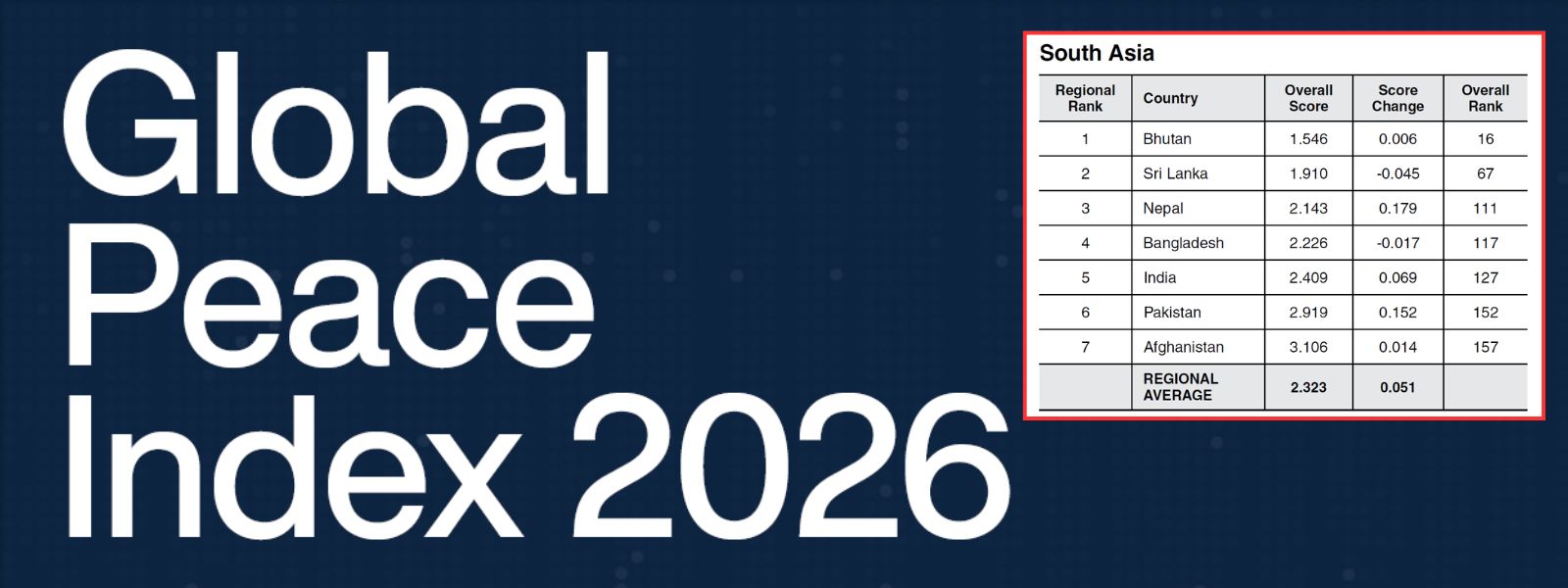
Global Peace Index 2026: Sri Lanka Ranks 67 Globally ; South Asia’s 2nd Most Peaceful Nation



.png )
COLOMBO (News 1st); Sri Lanka has recorded a remarkable surge in global stability, climbing to 67th place in the Global Peace Index (GPI) 2026, a significant improvement from its 97th position in the previous 2025 report, marking one of the most notable progressions in the region.
The latest report, compiled by the Institute for Economics & Peace (IEP), highlights Sri Lanka as the country with the largest percentage improvement in South Asia, with its overall peace score improving by 2.3 percent.
This sharp rise reflects the country’s gradual recovery and stabilisation following the severe economic crisis of 2022, which had previously weighed heavily on public confidence and national security perceptions.
According to the 2026 index, Sri Lanka is now ranked as the second most peaceful country in South Asia, behind only Bhutan, which holds the region’s top position at 16th globally.
Nepal follows Sri Lanka at 111th, with Bangladesh ranked 117th, India at 127th, Pakistan at 152nd, and Afghanistan at 157th, underscoring Sri Lanka’s relatively strong position within a region that continues to struggle with broader stability challenges.
Sri Lanka’s improved ranking has been driven primarily by gains in the Militarisation domain, which saw a 6.4 percent improvement. A key factor in this progress was a significant 40.8 percent improvement in the United Nations peacekeeping funding indicator, reflecting stronger international engagement and defence stabilisation efforts.
Further gains were recorded in the Safety and Security domain, which improved by 1.8 percent, driven largely by a notable 25 percent improvement in the political instability indicator.
These indicators suggest a reduction in internal tensions and a strengthening of governance, contributing to enhanced public confidence in national stability.
The report attributes Sri Lanka’s progress to improving economic conditions following years of turbulence. Reduced inflationary pressures and ongoing economic reforms have played a key role in easing public dissatisfaction.
Notably, Sri Lanka’s economy recorded a five percent growth rate in 2024, while inflation remained negative, signalling a turnaround in macroeconomic conditions.
This recovery was further reinforced by a landmark debt restructuring agreement reached with international bondholders in late 2024, which has helped restore fiscal stability and improve investor confidence.
Despite these positive developments, the report also highlights ongoing vulnerabilities. Sri Lanka continues to face significant risk due to its high debt-to-GDP ratio of 101 percent and heavy reliance on energy imports, estimated at around 60 percent.
These structural challenges remain critical factors that could influence long-term stability if not managed effectively.
The Institute for Economics & Peace, an independent global think tank headquartered in Sydney, plays a key role in measuring and analysing peace trends worldwide. Through its Global Peace Index, it assesses peace as a tangible indicator of human well-being, economic performance, and sustainable development.
Note: News 1st's Juwaad Abdeen Contributed To This Report
Other Articles
-855570_550x300.jpg)
-855564_550x300.jpg)






Featured News




News 1st, MTV Channel (Pvt) Ltd, MBC Networks (Pvt) Ltd, 45/3, Braybrooke Street, Colombo-02.
T.P : +94 114 792 700,
Fax : +94 114 792 733
T.P : +94 114 792 700,
Fax : +94 114 792 733




 |  |  |
|---|---|---|
 |  |  |
 |  |  |
 |

.gif)