.webp)


The Bond Scam Every Sri Lankan Should Know: What Happened and Why It Still Matters



.png )
It starts with something very ordinary.
A government, like any family, needs money. There are roads to build, salaries to pay, hospitals to run. But when there isn’t enough money in hand, the government borrows.
One of the main ways it does this is through something called treasury bonds.
A treasury bond is simply a promise. The government says: “Give me money today, and I’ll give it back later with extra.” That extra is called interest. The longer you wait, the more interest you earn.
The Central Bank of Sri Lanka is the institution that manages this borrowing. It doesn’t sell bonds directly to everyone. Instead, it sells them to selected, approved companies called primary dealers. These companies can later sell the bonds to others, banks, institutions, or funds, in the secondary market.
That is how the system is supposed to work.
But in 2015, that simple system turned into one of the most controversial financial stories in Sri Lanka’s history.
In January 2015, a major political change took place. After nearly a decade under Mahinda Rajapaksa, a new government came into power.
On January 8, 2015, Maithripala Sirisena became President, and Ranil Wickremesinghe became Prime Minister.
This new administration was known as the Yahapalana government, promising good governance and transparency.
However, just 50 days later, events took a different turn.
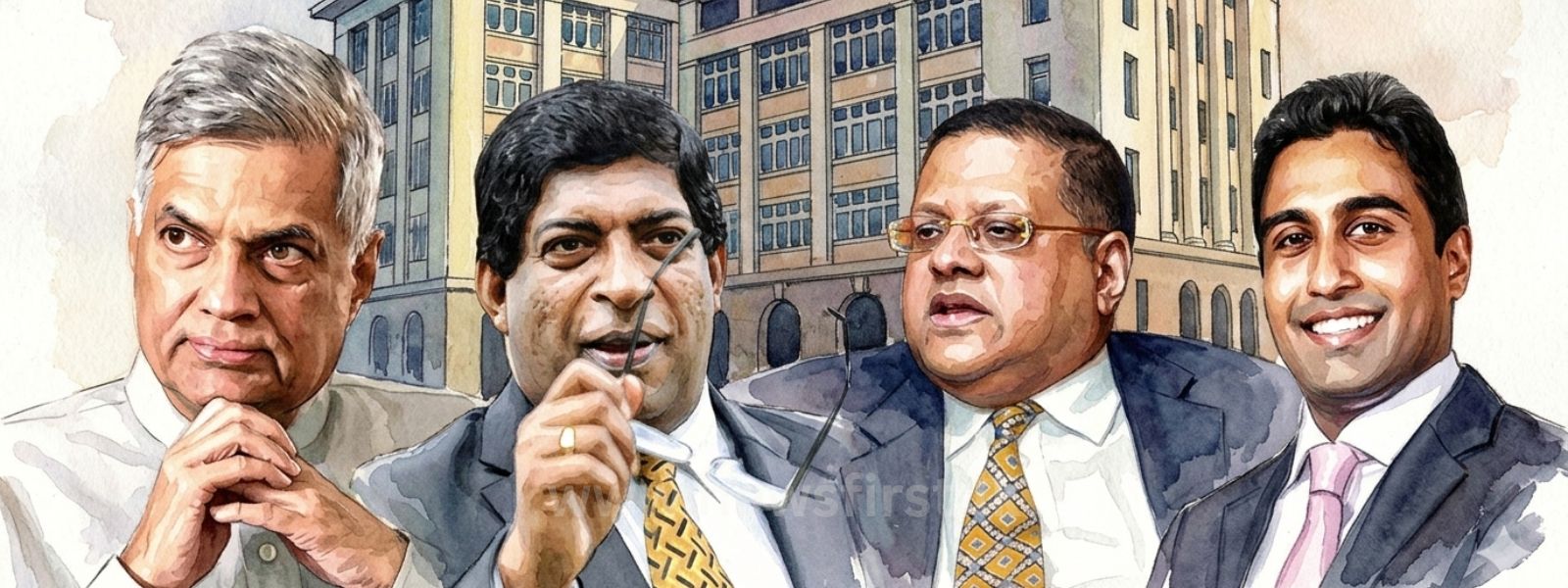
One morning, during an informal discussion, described as happening over tea, a key decision was made. Present at that discussion were Prime Minister Ranil Wickremesinghe, several ministers, the then UNP Chairman, and newly appointed Central Bank Governor Arjuna Mahendran, a Singaporean national whose appointment itself had faced resistance within the cabinet.
The topic was urgent: the government needed money to pay contractors involved in road development projects carried out during the previous administration. The figure discussed was around Rs. 15 billion.
Soon after, a treasury bond issuance was planned.
On February 27, 2015, the Central Bank announced that it would raise Rs. 1 billion through a bond auction. Primary dealers were invited to submit bids, stating how much they wanted and at what interest rate.
The system was competitive. The government would accept bids that best suited its needs. But as the auction was underway, something unexpected happened.
Governor Arjuna Mahendran personally arrived at the auction floor. This was highly unusual, previous governors did not intervene in auctions in this manner.
He examined the bids that had already been submitted and then gave instructions about how the process should proceed.
What followed changed everything.
Instead of accepting the planned Rs. 1 billion, the Central Bank accepted Rs. 10 billion worth of bids, ten times the original amount.
This sudden change raised serious questions. Why was such a large increase accepted without prior notice? Who benefited?
Investigations later revealed a crucial connection.
One of the largest bidders in that auction was a company called Perpetual Treasuries. Its owner was Arjun Aloysius, the son-in-law of Governor Arjuna Mahendran.
Perpetual Treasuries had submitted large bids at higher interest rates and secured a significant share of the bonds.
This created what is known as a conflict of interest, where a person in power is connected to a party that stands to benefit from decisions they influence.
Allegations emerged that Arjuna Mahendran used inside information and influenced the auction in a way that favored his son-in-law’s company.
But the story didn’t end there.
After securing these bonds, Perpetual Treasuries moved to the secondary market and began selling them.
One of the key buyers was the Employees’ Provident Fund (EPF), a fund made from monthly salary contributions of private sector workers. This is money people depend on for their retirement.
The EPF is itself a primary dealer and could have bought bonds directly at lower interest rates.
But instead, it ended up buying them later, at higher prices.
The result was staggering.
At one stage, losses to the EPF were estimated at around Rs. 8 billion, and the financial impact continued to grow. Added to this, later debt restructuring further reduced the expected returns from these bonds.
In other words, money meant to secure the future of workers had been exposed to significant loss. Multiple investigations followed. Findings emerged from the Presidential Commission of Inquiry, the Auditor General, and two reports by the Committee on Public Enterprises (COPE). Criminal investigations were also launched. These reports revealed several troubling details:
Prime Minister Ranil Wickremesinghe had advised that the bonds be issued through an auction method. This was revealed via testimony given by Mahendran at the Presidential Commission of Inquiry.
Governor Arjuna Mahendran, after receiving that advice, made the decision during the auction to accept a much larger amount, Rs. 10 billion. Perpetual Treasuries, owned by Arjun Aloysius, secured a large share of bonds at higher interest rates.
Other primary dealers and even a state bank were found to have placed bids that indirectly benefited Perpetual Treasuries, some at lower rates, some at higher rates.
The consequences spread beyond that one day. At one point, market interest rates reportedly increased by around 3% due to the transaction. The government ended up borrowing at higher costs, increasing the country’s overall debt burden.
And the most important detail: These bonds will only mature in 2048.
That means Sri Lankans, even future generations , will continue to feel the effects.
Despite the controversy in 2015, similar transactions occurred again in 2016, particularly on March 29 and March 31.
At that time, Ravi Karunanayake was the Finance Minister. Ahead of the auctions, he summoned senior officials of state banks and instructed them to submit bids at lower interest rates, saying it was necessary to control interest rates.
However, the outcome again appeared to favor Perpetual Treasuries, and state banks later said they incurred losses by following those instructions. The total losses from these transactions have still not been fully calculated. As investigations continued, more developments unfolded.
Governor Arjuna Mahendran left the country and has not been brought back. Ranil Wickremesinghe stated at one point that Mahendran had gone abroad for a private function and would return, but he has not.
Former President Maithripala Sirisena later claimed he signed over 21,000 documents in efforts to have Mahendran extradited.
Meanwhile, a COPE report chaired by D.E.W. Gunasekara was effectively halted when Parliament was prorouged before its release, removing its legal validity. A second COPE report under Sunil Handunnetti faced controversy after UNP MPs added footnotes, creating confusion.
The Presidential Commission report and its annexures have been sealed for 30 years, meaning they may only be fully accessible around 2048.
A separate report prepared by three members aligned with Ranil Wickremesinghe’s party cleared Arjuna Mahendran, stating no wrongdoing occurred in the bond auction.
Despite all of this, criminal investigations and court proceedings are still ongoing.
And while this story may seem complex, its impact is very real.
When the government borrows at higher interest rates, the country pays more.
And when the country pays more, the people pay more.
It appears in everyday life, in fuel prices, electricity bills, loan interest rates, and the overall cost of living.
In the end, treasury bonds are not just financial tools. They are promises made in the name of the people.
And when those promises are mishandled, it’s not just numbers on paper, it becomes a burden carried by an entire nation, for years, even decades to come.
Other Articles









Featured News

-835300_550x300.jpg)

News 1st, MTV Channel (Pvt) Ltd, MBC Networks (Pvt) Ltd, 45/3, Braybrooke Street, Colombo-02.
T.P : +94 114 792 700,
Fax : +94 114 792 733
T.P : +94 114 792 700,
Fax : +94 114 792 733




 |  |  |
|---|---|---|
 |  |  |
 |  |  |
 |

.gif)