.webp)


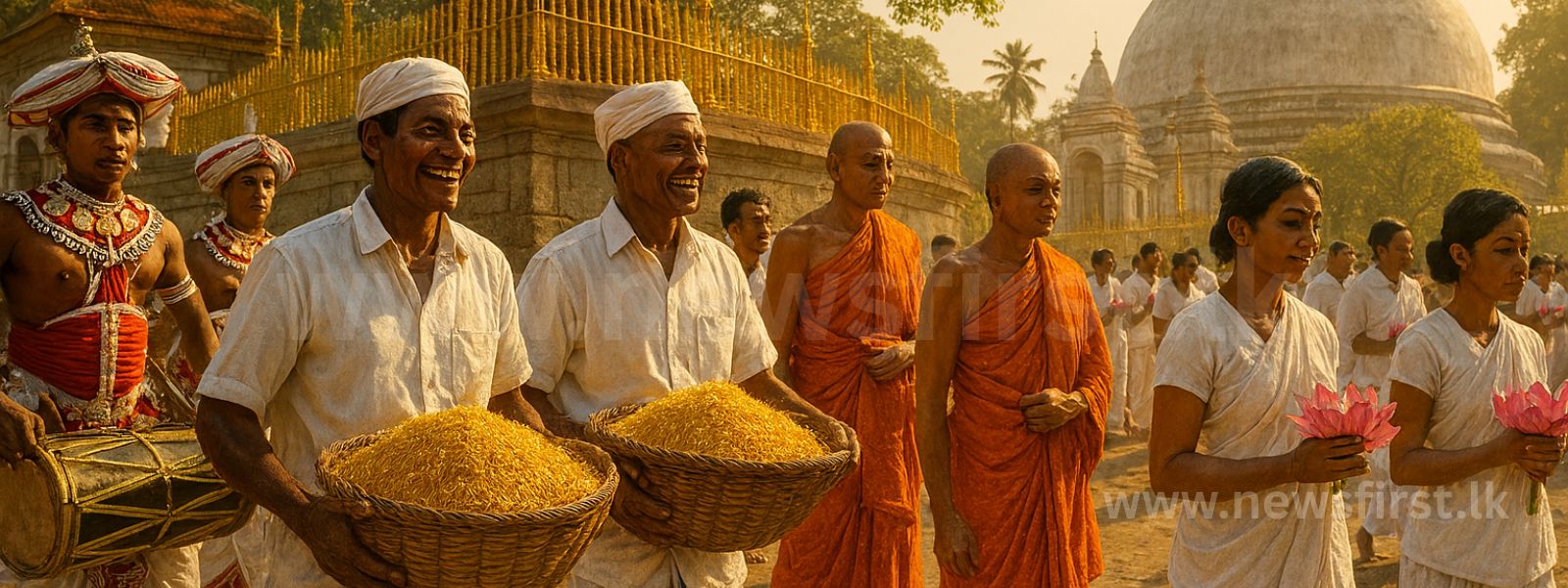
Before Rice Reaches the Plate, It Reaches the Sacred Tree: Inside Sri Lanka's New Rice Festival



.png )
COLOMBO (News 1st); In Anuradhapura, the nation's ancient capital, rice is never just rice.
Every year, before a single grain of the new harvest reaches a kitchen, a marketplace, or a supermarket, it takes a quieter journey, to the sacred courtyard of the Sri Maha Bodhiya.
There, beneath the canopy of a tree grown from the very branch under which the Buddha attained enlightenment, Sri Lanka renews one of its oldest promises.
This is Aluth Sahal Mangallaya, the New Rice Festival, an observance that reveals how deeply food, faith and statecraft are woven into the country’s history.
What Is Aluth Sahal Mangallaya, Really?
At its core, Aluth Sahal Mangallaya is the ritual offering of freshly harvested rice, mainly from the Yala cultivation season, to the Sri Maha Bodhiya in Anuradhapura.
It is not a harvest celebration marked by feasting or trade. Farmers symbolically pause the cycle of consumption and commerce to first acknowledge gratitude, for rain, soil, labour and continuity.
Only after this offering is made does the new rice become 'socially permissible' to eat or distribute.
In this sense, the festival marks not abundance, but responsibility.
Why Is Anuradhapura the Heart of the New Rice Festival?
Anuradhapura is not incidental to Aluth Sahal Mangallaya. It is foundational.
This city was the seat of Sri Lanka’s earliest hydraulic civilisation, a kingdom sustained by vast reservoirs, irrigation canals and seasonal cultivation carefully synchronized with monsoons. Food security was not theoretical here; it was existential.
How Does the Ceremony Happen Today?
The observance in Anuradhapura is restrained, symbolic and tightly ritualized.
Farmers from across the island contribute small quantities of paddy from their first harvest.
The rice is cleaned and placed in a golden ceremonial vessel, representing collective abundance.
Offerings are made at the Sri Maha Bodhiya with Buddhist chants invoking protection, balance and continuity.
What stands out is what doesn’t exist, no commercial branding, no trading, no consumption.
From Kings to the Modern State:
Historically, Sri Lankan monarchs treated Aluth Sahal Mangallaya as a state function, closely tied to legitimacy and stewardship. Kings publicly took part to signal that governance began with safeguarding the land and those who worked it.
Today, the ceremony in Anuradhapura continues under state patronage, often attended by the President and senior officials. While the political system has changed, the symbolism has not.
Aluth Sahal Mangallaya is a reminder that Sri Lanka’s civilisation did not rise on trade alone, but on agriculture guided by norms.
Other Articles


-842611_550x300.jpg)
-842605_550x300.jpg)





Featured News

-835300_550x300.jpg)

News 1st, MTV Channel (Pvt) Ltd, MBC Networks (Pvt) Ltd, 45/3, Braybrooke Street, Colombo-02.
T.P : +94 114 792 700,
Fax : +94 114 792 733
T.P : +94 114 792 700,
Fax : +94 114 792 733




 |  |  |
|---|---|---|
 |  |  |
 |  |  |
 |

.gif)