.webp)


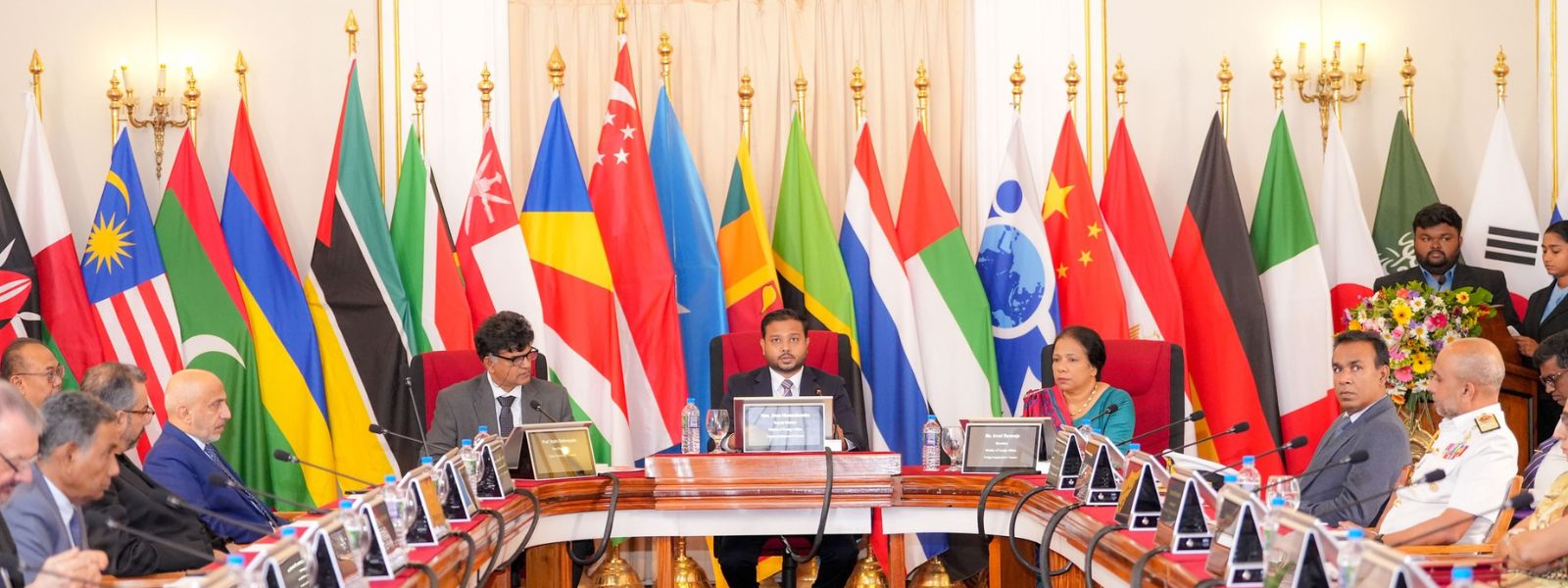
Sri Lanka Reasserts Call for Indian Ocean Zone of Peace



.png )
COLOMBO (News 1st); The concept of the Indian Ocean as a Zone of Peace, a vision first championed by Sri Lanka more than five decades ago, took centre stage again as Deputy Minister of Foreign Affairs and Foreign Employment Arun Hemachandra called for renewed commitment to safeguarding one of the world’s most vital maritime regions.
He said Sri Lanka’s historic leadership in advancing the Indian Ocean Zone of Peace Resolution of 1971 continues to shape present-day conversations on regional security and cooperation.
Hemachandra underscored that the Indian Ocean is far more than a geographic expanse. He described it as “the lifeblood of global commerce, a critical artery of energy flows and a source of livelihoods for millions across our region,” connecting continents, sustaining economies and influencing geopolitical and environmental realities.
He said Sri Lanka’s regional outlook is shaped by its position along major east-west maritime routes and highlighted the importance of protecting sea lines of communication, safeguarding submarine cables and upholding freedom of navigation and overflight under international law.
As a founding member of the Indian Ocean Rim Association, Sri Lanka “firmly believes that the Indian Ocean must remain a zone of peace governed by international law and guided by cooperation.” Hemachandra reaffirmed the country’s unwavering commitment to a rules-based maritime order consistent with the United Nations Convention on the Law of the Sea.
He stressed that ensuring the Indian Ocean remains secure, economically vibrant and environmentally sustainable is a shared responsibility of both regional and extra-regional governments. The ocean, he said, must preserve its distinct strategic identity while respecting the sovereign rights of its littoral states even as broader geopolitical frameworks evolve.
Hemachandra also emphasised effective ocean governance as essential for the sustainable use and equitable management of marine resources for current and future generations. Strengthening maritime domain awareness and enhancing search and rescue capabilities among coastal states, he said, remain vital for maritime safety, environmental protection and humanitarian response.
He noted that Sri Lanka has consistently demonstrated its commitment by expanding its national search and rescue capacity and actively assisting vessels and individuals in distress,actions he said were clearly visible during recent events in the Indian Ocean.
Hemachandra said achieving these ambitions depends on strong regional architecture, partnerships and cooperation, underscoring why the role of the Indian Ocean Rim Association “remains so important for countries like Sri Lanka.”
Other Articles
-830629_550x300.png)

-830610_550x300.jpg)
-830604_550x300.jpg)
-830580_550x300.jpg)




Featured News



News 1st, MTV Channel (Pvt) Ltd, MBC Networks (Pvt) Ltd, 45/3, Braybrooke Street, Colombo-02.
T.P : +94 114 792 700,
Fax : +94 114 792 733
T.P : +94 114 792 700,
Fax : +94 114 792 733




 |  |  |
|---|---|---|
 |  |  |
 |  |  |
 |

.gif)