.webp)


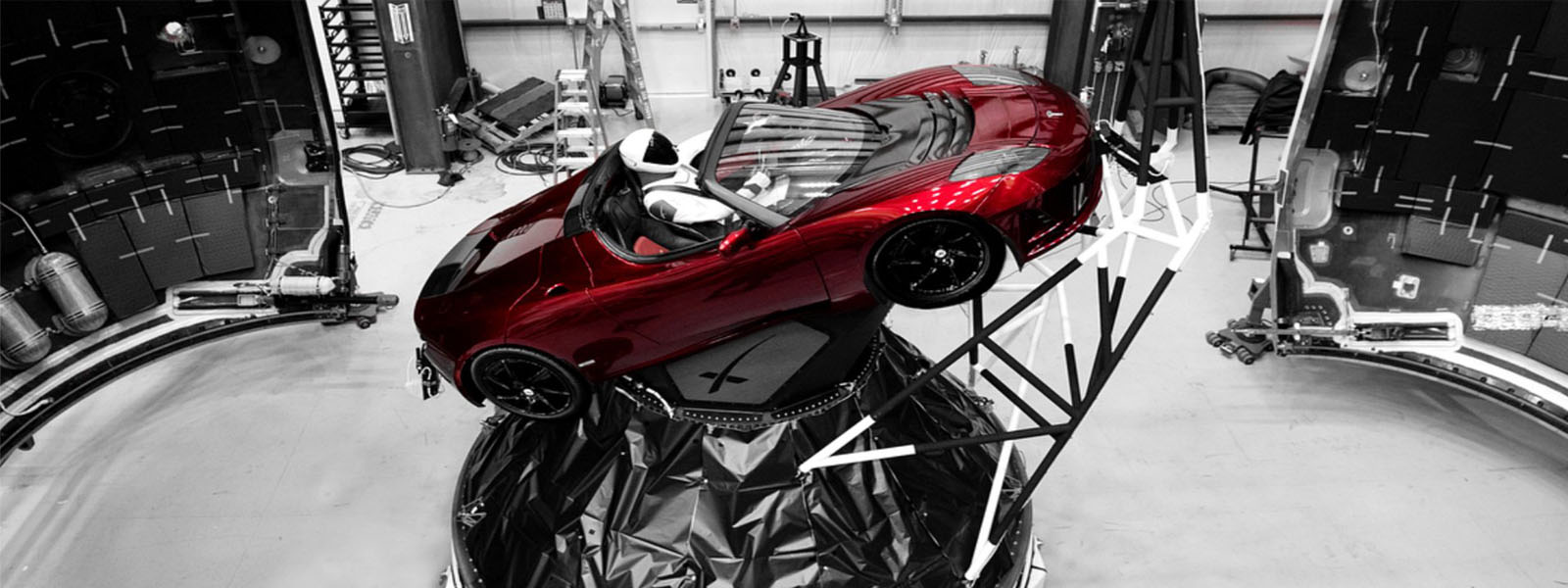
Elon Musk sent his Tesla Roadster into space -because why not? (Photo & Video)



.png )
Elon Musk is a tech genius and billionaire who has changed the world as we know it and is continuing to do so.
Musk's Tesla cars revolutionized and boosted the Electric Car technology while SpaceX kept on researching & developing re-usable space rockets and hyperloop technology.
However, not all of his plans went smooth. Considering the rocket accidents alone, he ran into trouble with his original Falcon 1 test flight and up to his follow-up Falcon 9s.
One of the Falcon 9s exploded on the launching pad during an ignition test in 2016.
In his latest project, Musk gave the world a big sized heavy space rocket 'Falcon Heavy', after decades since such a big rocket was used for the last time.
[caption id="attachment_182485" align="aligncenter" width="444"] This image is not a failed attempt in Image Editing. Yes, that is an actual car -IN SPACE![/caption]
On it's very first test flight, SpaceX's new rocket blasted off carrying a special payload.
This 'special' payload was Elon Musk's own red Tesla Roadster -which is off on an endless road trip past planet Mars.
The Roadster's circuit board has "Made on Earth by humans" imprinted on it -Because, you know, just in case its discovered by Aliens...
[caption id="attachment_182488" align="aligncenter" width="388"]
This image is not a failed attempt in Image Editing. Yes, that is an actual car -IN SPACE![/caption]
On it's very first test flight, SpaceX's new rocket blasted off carrying a special payload.
This 'special' payload was Elon Musk's own red Tesla Roadster -which is off on an endless road trip past planet Mars.
The Roadster's circuit board has "Made on Earth by humans" imprinted on it -Because, you know, just in case its discovered by Aliens...
[caption id="attachment_182488" align="aligncenter" width="388"] Just in case its discovered by Aliens....[/caption]
Falcon Heavy is a combination of three Falcon 9s, the rocket which SpaceX use to send supplies to the International Space Station. However, This Falcon will be doing much more than carrying supplies to the ISS.
This is intended for massive satellites of the likes used by the US military and big-time communication companies.
Just in case its discovered by Aliens....[/caption]
Falcon Heavy is a combination of three Falcon 9s, the rocket which SpaceX use to send supplies to the International Space Station. However, This Falcon will be doing much more than carrying supplies to the ISS.
This is intended for massive satellites of the likes used by the US military and big-time communication companies.
 Revolutionary 'Falcon Heavy' lifted off from Kennedy Space Centre, on the very launch pad used by NASA 50 years ago when it sent men to the Moon.
As it began it's journey, Falcon Heavy went into the record books as the most powerful rocket in use at present.
This rocket packed double the lift-off puch of it's closest competitor, the Saturn V rockets which carried men to the moon during the Apollo era.
[caption id="attachment_182494" align="aligncenter" width="431"]
Revolutionary 'Falcon Heavy' lifted off from Kennedy Space Centre, on the very launch pad used by NASA 50 years ago when it sent men to the Moon.
As it began it's journey, Falcon Heavy went into the record books as the most powerful rocket in use at present.
This rocket packed double the lift-off puch of it's closest competitor, the Saturn V rockets which carried men to the moon during the Apollo era.
[caption id="attachment_182494" align="aligncenter" width="431"] The Falcol Heavy at Kennedy Space Centre[/caption]
The boosters are only re-usable if they return to earth. And return, they did.
Two of the boosters, recycled after being used before, were programmed to return for a simultaneous touchdown at Cape Canaveral.
The third booster which is brand new, set its sights on an ocean platform almost 500 KM offshore.
The Falcol Heavy at Kennedy Space Centre[/caption]
The boosters are only re-usable if they return to earth. And return, they did.
Two of the boosters, recycled after being used before, were programmed to return for a simultaneous touchdown at Cape Canaveral.
The third booster which is brand new, set its sights on an ocean platform almost 500 KM offshore.
This image is not a failed attempt in Image Editing. Yes, that is an actual car -IN SPACE![/caption]
On it's very first test flight, SpaceX's new rocket blasted off carrying a special payload.
This 'special' payload was Elon Musk's own red Tesla Roadster -which is off on an endless road trip past planet Mars.
The Roadster's circuit board has "Made on Earth by humans" imprinted on it -Because, you know, just in case its discovered by Aliens...
[caption id="attachment_182488" align="aligncenter" width="388"] Just in case its discovered by Aliens....[/caption]
Falcon Heavy is a combination of three Falcon 9s, the rocket which SpaceX use to send supplies to the International Space Station. However, This Falcon will be doing much more than carrying supplies to the ISS.
This is intended for massive satellites of the likes used by the US military and big-time communication companies.
Revolutionary 'Falcon Heavy' lifted off from Kennedy Space Centre, on the very launch pad used by NASA 50 years ago when it sent men to the Moon.
As it began it's journey, Falcon Heavy went into the record books as the most powerful rocket in use at present.
This rocket packed double the lift-off puch of it's closest competitor, the Saturn V rockets which carried men to the moon during the Apollo era.
[caption id="attachment_182494" align="aligncenter" width="431"] The Falcol Heavy at Kennedy Space Centre[/caption]
The boosters are only re-usable if they return to earth. And return, they did.
Two of the boosters, recycled after being used before, were programmed to return for a simultaneous touchdown at Cape Canaveral.
The third booster which is brand new, set its sights on an ocean platform almost 500 KM offshore.
Falcon Heavy side cores have landed at SpaceX’s Landing Zones 1 and 2. pic.twitter.com/oMBqizqnpI
— SpaceX (@SpaceX) February 6, 2018
Longer the better
According to Elon Musk, the longer the flight, the more SpaceX would learn from the rocket. Meanwhile SpaceX is hoping for live shots of the car from on-board cameras, once the protective enclosure comes off and the car sails off fully exposed. Live footage from the Roadster: Musk's car will have to brace through a set of obstacles before settling in, though.1. Survive lift-off
2. Endure a cosmic bombardment on its several hours of cruising through the highly charged Van Allen radiation belts
3. A thruster has activate and send the Roadster into the right orbital course
Musk says the car will reach Mars in six months, if it gets through these obstacles.Cheaper the better
Its sticker price is $US90 million, less than one-tenth the estimated cost of NASA's Space Launch System megarocket in development for Moon and Mars expeditions. According to Musk, Falcon Heavy will not carry passengers. However, this rocket will definetely accelerate the development of an even bigger rocket to accommodate deep-space crews.More photos from Falcon Heavy's first flight → https://t.co/095WHX44BX pic.twitter.com/6vlXJoYif0
— SpaceX (@SpaceX) February 7, 2018
Other Articles

-854451_550x300.jpg)






Featured News





News 1st, MTV Channel (Pvt) Ltd, MBC Networks (Pvt) Ltd, 45/3, Braybrooke Street, Colombo-02.
T.P : +94 114 792 700,
Fax : +94 114 792 733
T.P : +94 114 792 700,
Fax : +94 114 792 733




 |  |  |
|---|---|---|
 |  |  |
 |  |  |
 |

.gif)